



by Bruce Keith, on November 1, 2026
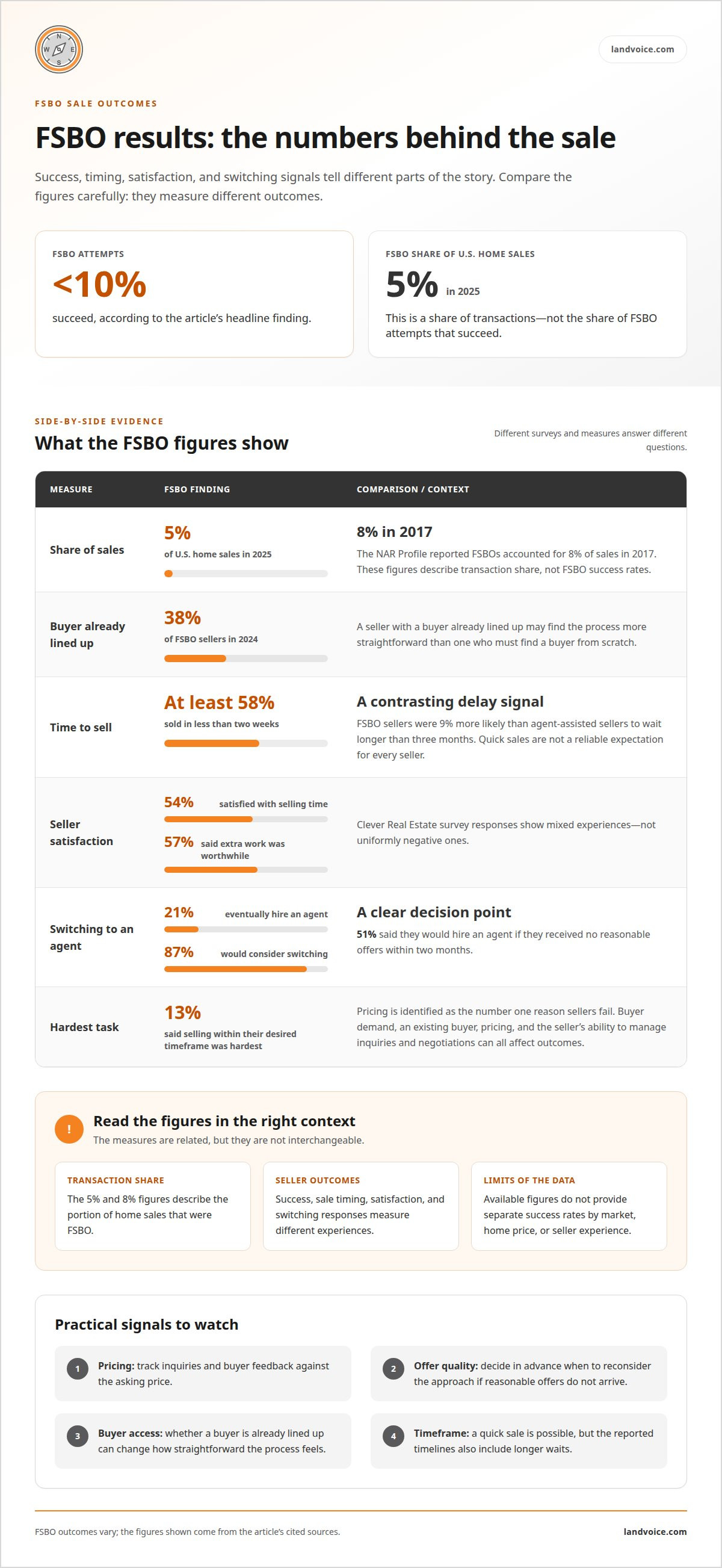
Less than 10% of FSBOs succeed, so most attempts don’t end in a successful sale. That’s the clearest answer to what percentage of FSBOs fail, but the reasons behind a failed sale matter just as much as the headline figure.
Selling on your own can seem like a straightforward way to stay in control. But setting the right price is a major challenge, and paperwork, negotiations, and closing steps can put a promising deal at risk. Knowing where sales get derailed helps you spot problems early and decide when professional support could make a difference.
This guide explains how FSBO sales fare, why some homes sell quickly while others struggle, and which legal and paperwork mistakes can disrupt a transaction. You’ll also learn how an agent can help with pricing, exposure, buyer negotiations, and the work that follows an accepted offer. Use these details to assess your options, protect the sale process, and choose your next step with more confidence.
Key Takeaways
- About 21% of U.S. sellers who start out selling on their own eventually hire an agent, showing that changing course can be part of the process.
- Paperwork can be a major hurdle: 10% of FSBO sellers ranked it as the hardest task, and legal mistakes can put a transaction at risk.
- Before closing, keep the key steps organized, including the buyer’s written mortgage commitment, inspection deadlines, contract review, and title work.
- An agent can help broaden a listing’s exposure, manage negotiations, and coordinate the steps between an accepted offer and closing.
- Real estate professionals can use FSBO leads to connect with homeowners who are currently trying to sell without an agent.
1. FSBO sale success rate
Less than 10% of FSBOs succeed, so most attempts don’t end in a successful sale. That gives a broad answer to what percentage of FSBOs fail, but the result depends on what counts as failure and which sellers are included.
FSBO sales made up 5% of all U.S. home sales in 2025. For comparison, they accounted for 8% of sales in the NAR 2017 Profile of Home Buyers and Sellers. These figures describe the share of transactions, not the share of FSBO attempts that succeed. Some sellers already have a buyer lined up: about 38% of FSBO sellers in 2024 did. A seller who already has a buyer may find the process more straightforward than one who has to find a buyer from scratch.
Many sellers are willing to change course. About 21% of U.S. sellers who try selling on their own eventually hire an agent. In a Clever Real Estate survey, 87% of FSBO sellers said they would consider switching to an agent. Another 51% said they would hire an agent if they received no reasonable offers within two months. These responses point to a practical reason for abandoning FSBO: the home isn’t attracting acceptable offers within the seller’s timeframe.
Satisfaction is mixed, not uniformly negative. In a Clever Real Estate survey, 54% of FSBO sellers were satisfied with how long selling took, and 57% said the extra work was worthwhile to save money. Yet FSBO sellers are 9% more likely than agent-assisted sellers to wait longer than three months. Timing is a common pain point: 13% of FSBO sellers said selling within their desired timeframe was the hardest part.
Do FSBO success rates vary by market, home price, or seller experience? Outcomes can depend on buyer demand, pricing, whether a buyer is already lined up, and the seller’s ability to manage inquiries and negotiations. Available figures don’t break results down by market, price, or experience, so those factors may explain variation but don’t establish separate success rates.
How long do FSBO homes typically take to sell? At least 58% sold in less than two weeks, often to someone the seller knew, while FSBO sellers were more likely to wait longer than three months. Those contrasting outcomes show why a quick sale isn’t a reliable expectation for every seller.
Incorrect pricing is identified as the number one reason sellers fail. Track inquiries and compare buyer feedback with the asking price, then decide in advance when to reconsider your approach. Setting a decision point can help prevent a difficult sale from dragging on without a clear plan.
2. Paperwork and legal mistakes
Paperwork can turn an accepted offer into a stalled closing. In the United States, 10% of FSBO sellers ranked paperwork as the hardest task. Around 43% of sellers acknowledge making legal mistakes because they didn’t have an agent. These figures underline why homeowners need a clear document process before a home is listed and after a buyer agrees to purchase.
Start with the purchase agreement. Check that the property details, sale terms, deadlines, and included items reflect what both sides negotiated. If an appliance is excluded, for example, the written agreement should match that understanding. Keep signed copies and track amendments so both sides are working from the same terms. Put any change in writing rather than relying on a casual verbal agreement.
Before closing, organize these steps:
- Make sure the buyer obtains a written mortgage commitment.
- Track inspection deadlines and confirm inspections happen within the allotted time.
- Have attorneys review and approve the contract.
- Review title work and resolve questions before closing.
- Document amendments and confirm why each change is needed.
Deadlines matter because inspection and financing steps can affect a transaction’s progress. Missing an inspection window, for instance, may limit your chance to address buyer concerns within the agreed process. Keep a calendar of due dates, the responsible party, and the document or response needed. This simple record helps you follow up instead of relying on memory.
Give title work focused attention. It relates to ownership and the property’s path to closing, so raise questions early rather than waiting until the final paperwork stage. An attorney’s contract review can help identify unclear terms and explain transaction-related legal issues. Keep a complete file of the signed agreement, title documents, inspection records, and written changes.
Keep the sale price separate from commission discussions. A buyer may have an agent, and FSBO sellers can still face a buyer’s agent commission. Put any agreed terms in writing and make sure they align with the purchase agreement. Clear records help both sides understand what was negotiated, what remains due, and which paperwork supports closing.
Use one transaction checklist from offer through closing. Record each document received, review changes before signing, and save the final versions. For homeowners selling without an agent, this makes missing paperwork easier to spot and gives an attorney a clearer record to review.
3. Benefits of hiring a real estate agent
A real estate agent can bring structure to pricing, marketing, and negotiating a home sale. In the NAR 2017 Profile of Home Buyers and Sellers, agent-assisted sellers accounted for 89% of sellers. That figure shows how common professional representation is. The practical value comes from coordinated work across the listing, buyer conversations, and offer process.
Pricing is a critical first step. An agent can review comparable listings and sales, then help set an asking price that reflects the home and its market. Price too high, and potential buyers may overlook the property. Price too low, and you may leave value on the table. Local comparisons and buyer feedback give you a clearer basis for deciding whether to adjust the asking price.
Marketing takes sustained attention. FSBO homes may appear on only a few websites, limiting exposure. An agent can coordinate listing details, photography, descriptions, and showings across marketing channels. Broader exposure can put a home in front of more potential buyers. Agent-listed homes can sell within an average of three weeks, though timing depends on factors such as price, demand, and property condition.
Buyer access matters, too. An agent can communicate with buyer representatives, schedule showings, and respond to inquiries while you handle other responsibilities. When an offer arrives, the agent can help compare its terms, explain negotiation options, and keep the transaction moving toward closing.
How much do FSBO sellers save on commission, and what costs do they incur? Selling without a listing agent may avoid that agent’s commission, but FSBO sellers may still face a buyer’s agent commission, typically about 2.5-3% of the selling price. Net savings depend on agreed compensation and other transaction expenses, so avoiding one commission doesn’t eliminate every sale-related cost.
Agents can also act as intermediaries when negotiations become difficult. If a buyer requests repairs after an inspection, for example, an agent can help both sides discuss options and communicate clearly. After accepting an offer, sellers must coordinate the parties and next steps. An agent can track participants, deadlines, and outstanding actions to help keep the process organized through closing.
Professional help may be especially useful if you need broader listing exposure, support managing buyer inquiries, or guidance during negotiations. Compare those needs with the work you’re prepared to manage yourself. Your priorities, the home’s circumstances, and your comfort with each step should guide your decision. An agent can take on key parts of the process while you remain involved in decisions about your home and sale.
4. Getting professional help with the sale
Professional help can address the points that often feel hardest when selling by owner: pricing, preparation, buyer access, and transaction details. An appraiser can assess a home’s value and suggest a listing price, giving you a firmer starting point than relying only on nearby listings or personal expectations.
Before the first showing, consider a professional home inspection. It may surface issues that would otherwise emerge during a buyer’s inspection, giving you time to understand the findings and prepare. Use the report to prioritize repairs and gather relevant records. Documentation of completed work, for example, can help explain the home’s condition during negotiations.
Attorney support is another practical option for FSBO sellers. A real estate attorney can advise on transaction-related legal matters, paperwork, contracts, and regulations. Bring the proposed contract, written offer terms, and any amendments for review before signing, especially when terms change or a request affects the closing timeline.
Buyer access also deserves a clear plan. Consider offering a buyer’s agent commission so represented buyers remain part of your potential audience. Discuss and document any compensation terms clearly rather than leaving them to assumption during negotiations.
Use a simple sequence to prepare:
- Arrange an appraisal and use its valuation to inform the asking price.
- Schedule a professional inspection before listing and review its findings.
- Organize property records, repair documents, and details for the listing.
- Set showing procedures and decide how inquiries will be handled.
- Have an attorney review the contract and transaction documents.
Each step supports a different part of the sale. An appraisal informs pricing; an inspection helps you prepare; an attorney can address contract questions. Together, these professionals can help identify decisions that need attention before they become obstacles to closing. Keep notes on recommendations and the actions you choose to stay organized.
Choose help based on the challenge at hand. If pricing is uncertain, start with an appraiser. If the home’s condition needs attention, arrange an inspection. If contract language or transaction paperwork raises questions, consult a real estate attorney. This focused approach lets FSBO homeowners bring in expertise where it can strengthen the sale process.
5. How is FSBO failure defined in real estate statistics?
“Failure” can describe different outcomes, so any percentage needs a clear definition. A homeowner might withdraw a listing, hire an agent and sell, or remain unable to complete a sale. Those outcomes aren’t interchangeable. Before interpreting a rate, identify what the statistic counts as an unsuccessful FSBO attempt.
Start by separating the denominator from the outcome. A statistic about FSBOs’ share of completed home sales counts transactions that closed. It doesn’t show how many homeowners tried selling alone and later changed course. A seller who hires an agent and closes, for example, may appear in agent-assisted sales, not completed FSBO sales. That changes the reported category without showing whether the original attempt ended in a sale.
Time also affects what a result means. A home still listed at the end of a study period may be classified as unsold, even if it sells later. A withdrawn listing might reflect a pause, a change in plans, or a switch to another selling method. Without a stated observation window and outcome rules, it’s impossible to tell which cases a reported rate includes.
Compare the measure with the question you need answered:
- For completed-sale share, check whether the figure counts closed transactions only.
- For FSBO success, look for the number of sellers who began without an agent.
- For abandonment, see whether switching to an agent counts as failure.
- For speed, identify the time period used to track each listing.
- For a failed transaction, distinguish an accepted offer from a completed closing.
These distinctions matter because “attempts,” “listings,” and “sales” describe different groups. A listing count may include repeated attempts by one homeowner, while a seller count may treat that person as one participant. A completed-sale count excludes homes that remain active or are withdrawn. Each denominator answers a different question, so compare percentages only when their definitions align.
Look at the reported method, not the headline alone. If a survey asks sellers whether they eventually hired an agent, for instance, it measures a change in approach, not necessarily whether they ultimately sold. A transaction report can show the share of sales completed without an agent, but not every unsuccessful attempt. Read the definition, timeframe, and population together.
For a useful comparison, note three details beside every FSBO statistic: who was counted, what outcome qualified as success, and when results were measured. This quick check makes claims about FSBO failure easier to interpret and helps prevent a sales-share figure from being mistaken for an attempt-success rate.
Landvoice: Expired Pro
Landvoice’s Expired Pro and FSBO Leads give real estate agents options for building seller-focused prospecting pipelines. If you want to connect with homeowners currently attempting to sell without an agent, FSBO Leads are the relevant fit. Expired Pro is another named offering for agents developing listing opportunities.
Use these resources to turn your understanding of FSBO challenges into focused outreach. Conversations can help homeowners consider their next steps, whether they’re reassessing their selling approach or seeking professional support. Match your prospecting to the seller situations you want to pursue, then build a consistent contact workflow.
Visit Landvoice to explore the options.
Turn FSBO insight into your next step
Understanding what percentage of FSBOs fail can sharpen your approach to homeowners, but the statistic alone won’t build a stronger prospecting pipeline. Use what you’ve learned to plan thoughtful conversations around sellers’ needs, timing, and next steps. Focus on clear communication and practical support, not pressure.
For agents looking to expand their outreach, Landvoice offers FSBO Leads and FRBO Leads to support conversations with homeowners in those selling situations. Choose the lead source that aligns with your outreach goals, then take a consistent, professional approach to each contact.
When you’re ready to build a more focused workflow, start with a clear outreach goal, make room for meaningful homeowner conversations, and refine your approach as you learn what resonates.
Your next strong connection can start with one thoughtful conversation.
Frequently Asked Questions
What percentage of FSBO homes fail to sell?
Fewer than 10% of FSBO attempts are reported as successful, meaning most don’t reach a successful sale under that estimate. The exact failure rate depends on whether a measure counts withdrawn listings, homes that remain unsold during a study period, or sellers who later hire an agent. Check what outcome and timeframe a statistic uses before treating it as a definitive failure rate.
What percentage of FSBO sellers eventually hire a real estate agent?
About 21% of U.S. sellers who try selling on their own eventually hire an agent. A Clever Real Estate survey also found that 87% of FSBO sellers would consider switching. These figures reflect different measures: one tracks sellers who actually change course, while the other captures willingness. For a seller, a useful decision point is whether buyer interest and offers match the expected timeline.
What percentage of FSBO homes sell compared with agent-listed homes?
FSBO homes accounted for 5% of all U.S. home sales in 2025. That figure describes the share of completed sales, not the success rate of all FSBO attempts. The NAR 2017 Profile of Home Buyers and Sellers reported that FSBO sales represented 8% of sales, while agent-assisted sellers represented 89% of sellers. Those figures come from different categories and shouldn’t be treated as a direct success-rate comparison.
What are the most common reasons FSBO homes don't sell?
Incorrect pricing is identified as the number one reason sellers fail. Limited listing exposure can also reduce the number of potential buyers who see a home. In a Clever Real Estate survey, 44% of FSBO sellers said they didn’t use a home valuation tool. A practical first move is to review comparable listings and buyer feedback, then adjust the marketing or asking price when interest remains weak.
What does the latest NAR data say about FSBO home sales and outcomes?
The NAR 2017 Profile of Home Buyers and Sellers reported that FSBOs accounted for 8% of U.S. home sales. That statistic measures the share of sales, not how many FSBO attempts failed or later switched to agent representation. For context, FSBO homes accounted for 5% of all U.S. home sales in 2025, but that figure isn’t attributed to NAR here. Compare dates and measures carefully.
