



by Bruce Keith, on November 4, 2026
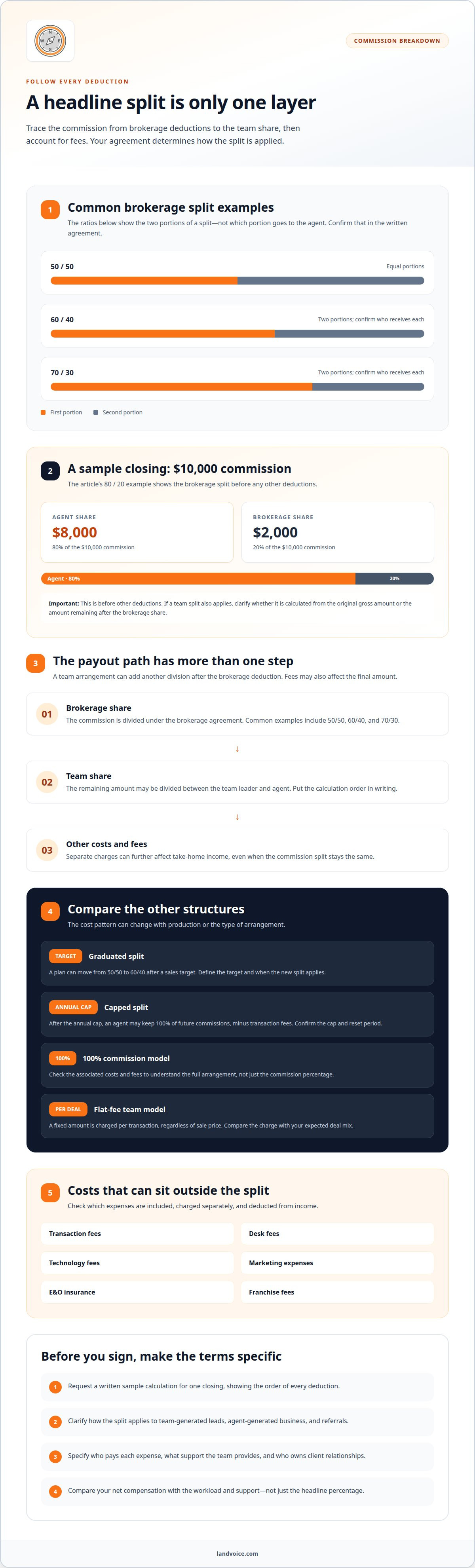
The headline split isn’t your take-home pay. Real estate team commission split models in 2026 vary, but commissions generally go to the brokerage first, then flow to the agent and team according to their agreements. Common brokerage splits include 50/50, 60/40, and 70/30, while team arrangements can add another layer.
Look beyond the percentage: a larger team share may come with leads, mentoring, or administrative support, while a smaller share may leave you responsible for more costs and tasks. Compare what you keep after every deduction with the support you receive.
This guide breaks down how commissions move between brokerages, team leaders, and agents. You’ll compare percentage, graduated, capped, 100% commission, and flat-fee models, then see what to clarify in a team agreement before you sign. Use the numbers and terms to assess the full arrangement, not just the split that sounds best.
Key Takeaways
- Trace each commission deduction from the transaction through the brokerage and team so you can see what reaches your pocket.
- Compare percentage, graduated, capped, 100% commission, and flat-fee structures by how their costs change with your production.
- Look beyond the headline split: desk, technology, transaction, marketing, insurance, and franchise fees can affect your net income.
- Clarify lead ownership, support, expenses, and split calculations in the team agreement before you commit.
- Match the team structure to the work and support you actually receive, then negotiate terms that reflect your contribution.
Negotiating commission splits
Negotiate the full payout path, not just the percentage shown in a team offer. A 70/30 brokerage split and a separate team split can both reduce your gross commission income before closing proceeds reach you.
Team Split Negotiations
A team split divides the commission remaining after brokerage deductions between the team leader and agent. The right terms depend on who supplies leads, handles administrative work, and provides mentorship. Compare the responsibilities against your net share: a 50/50 arrangement may make sense when the team provides substantial support, while agent-generated business can support a different negotiation. Put the calculation order in writing.
Many agents work as independent contractors and are responsible for self-employment and income taxes, as well as estimated tax payments. Licensing rules govern who receives and distributes commissions. RESPA considerations depend on whether compensation is for actual services or for referrals connected to settlement services.
State and Local Market Variations
Team splits depend on brokerage agreements, team support, lead sources, and local practices, not on one nationwide percentage. Oregon has a specific compensation pathway: compensation must pass through a Principal Broker, and the brokerage distributes the agent’s share under the independent contractor agreement. This affects how compensation is routed, not the need to negotiate your team terms.
Use this comparison to focus negotiations on the factors that shape your net income and workload:
| Option | How the split works | Negotiation focus |
|---|---|---|
| Fixed brokerage split | Common examples include 50/50, 60/40, and 70/30. | Clarify which share goes to the agent. |
| Graduated split | A plan can move from 50/50 to 60/40 after a sales target. | Define the target and when the new split applies. |
| Capped split | After the annual cap, an agent may keep 100% of future commissions, minus transaction fees. | Confirm the cap, reset period, and remaining fees. |
| Team split | The brokerage deducts its share before the remaining amount is divided. | Set out the calculation order and team contribution. |
| Flat-fee team model | A fixed amount is charged per transaction, regardless of sale price. | Compare the fixed charge with your expected deal mix. |
Before accepting an offer, request a written sample calculation for one closing. For example, on a $10,000 commission, an 80/20 split leaves the agent $8,000 and the brokerage $2,000 before other deductions. Ask whether a team split applies to the original gross amount or the remainder after brokerage deductions. Also define treatment of referrals, team-generated leads, and agent-generated business.
Negotiate support as carefully as the percentage. Specify who pays administrative expenses, who owns client relationships, and whether mentoring or lead support affects the split. Agree on when and how the arrangement will be reviewed as production changes, and document how disputes over calculations will be resolved. Choose terms that make your net compensation clear and reflect your contribution.
Questions to ask before signing a team agreement
A team offer can look attractive until deductions reduce your expected income. Before signing, match each compensation term, fee, and responsibility to a specific provision in the agreement. Then compare the written terms with how the brokerage handles a completed transaction.
Clarify the team agreement
Request a sample commission calculation showing the order of deductions, from the brokerage share to the team share. Confirm whether franchise fees are deducted before the split, since some brokerage arrangements calculate the agent’s share after that deduction. Ask which split applies to team-generated business, your own clients, and referrals, and get the answers in writing.
Use these questions to identify terms that can change your net compensation:
- Does the team split apply to gross commission income or the amount remaining after brokerage deductions?
- Which transaction, desk, technology, marketing, E&O insurance, and franchise fees are separate from the split?
- Who pays each expense, and when is it deducted from income?
- Who owns client relationships and records if you leave the team?
- How are referrals, team leads, and agent-generated clients handled at closing?
- What support, mentorship, or administrative work does the team provide in exchange for its share?
Fees matter even when the commission percentage stays the same. Ask whether services are included, optional, or charged separately. Then calculate how each arrangement affects your expected take-home income based on your likely production.
Questions for an office or local Market Center
Ask how the office applies the agreement to an actual closing, not just how it describes the model. Find out whether transaction fees apply to each deal, whether desk or technology costs continue during slower periods, and whether marketing expenses are shared. Terms can differ between Market Centers, so focus on the written agreement for the office you would join.
Ask who approves compensation changes and how they are documented. Confirm when a revised split takes effect, how pending transactions are handled, and whether the agreement covers termination and client handoffs. These details matter beyond your first closing. A clear answer identifies the responsible office representative and the relevant written term.
Before signing, summarize the split, deductions, lead rules, support, and exit process in writing. Compare the summary with the agreement and resolve any mismatch before committing. Precise terms make compensation easier to forecast and responsibilities easier to manage.
Traditional percentage splits versus 100% commission models
Traditional U.S. commissions were often around 5% to 6% of a home’s sale price. That total commission is distinct from the percentage an agent keeps under a brokerage or team agreement.
Traditional Percentage Splits
A traditional percentage split gives the brokerage a set share of the commission, with the agent receiving the remainder. Unlike a flat fee, the brokerage’s share changes with the commission amount. Team deductions may also apply, so calculate each stage separately. Compare the percentage with the support, services, and expenses covered by the agreement.
100% Commission Models
A 100% commission model removes the brokerage’s percentage share, but it can still charge other fees. Compare those fixed or deal-based charges with a percentage split, especially when production changes across the year.
Comparing Expected Net Income
To compare models, apply each agreement to the same expected transaction volume. Subtract the brokerage share, team deductions, and every recurring or closing fee. For example, an agent completing 10 solo deals at $8,000 net commission per deal earns $80,000 annually before solo expenses. This calculation answers which structure leaves more income at your production level.
A flat-fee team model charges a fixed amount per transaction, regardless of sale price. Unlike a percentage split, the fee does not increase when the commission on a sale is larger. Estimate the total fee across your expected closings, then compare it with percentage-based deductions. The better fit depends on your deal mix and the services included.
Large traditional team operations use staffing and systems to support higher transaction volume. One model comparison lists 225 or more transactions for a large traditional team. At that scale, the team’s costs and administrative structure matter alongside the agent’s share. Assess how the operation allocates work and whether its support matches the production it expects.
Expanded traditional teams can cover 150-300 or more transactions, while another recommendation suggests expanding a small traditional team at 300 or more transactions. These figures describe different planning points, not a single universal threshold. Compare the model’s staffing needs, workflow, and transaction capacity before treating growth as a reason to change splits.
Calculate net income under each model using the same production assumptions and including every fee. Then weigh the result against the support and transaction capacity you need.
How Do Commission Splits Work Between Agents and Brokerages?
The brokerage receives the commission first, then distributes the agent’s share under the agreement. Team deductions, caps, and fixed charges can further reduce what remains after each closing.
100% Commission, Capped-Split, and Hybrid Plans
A true 100% commission plan replaces the brokerage percentage split with fixed charges. A capped plan works differently: an agent pays an 80/20 split until brokerage contributions reach an annual $16,000 cap, then earns 100% of commissions. Hybrid plans combine percentage deductions with separate fees.
Compare the full charge structure, not the “100%” label. Experienced agents should calculate annual brokerage contributions, transaction fees, and any team deduction together. The cap’s reset period and the treatment of pending transactions also affect the final payout.
Graduated and Tiered Plans
A graduated plan changes the percentage as production rises. One example pays 70/30 on the first $50,000 of gross commission income, 80/20 until $100,000, then 90/10 for the rest of the year. Unlike a fixed split, this structure rewards higher production with a larger agent share after each threshold.
Confirm whether each tier applies to all gross commission or only the portion within that tier. The distinction changes the calculation. Get thresholds, timing, and annual reset terms in writing before comparing a tiered model with a cap.
Brokerage Splits and Additional Fees
A team split is separate from a brokerage split: the brokerage share is deducted first, then the team and agent divide the remainder under their agreement. Desk fees, technology, marketing, E&O insurance, transaction fees, and franchise charges can also reduce income. Calculate every deduction against the same gross commission.
Keller Williams’ described typical split is 64/30/6 for agent, brokerage, and franchise until a market-specific cap. Century 21 offices are independently owned and operated, and each office sets its split. For example, Century 21 Redwood Realty calculates splits after its 6% franchise fee and applicable referral fees.
Costs beyond the split may include recurring desk or technology charges, per-transaction fees, marketing expenses, E&O insurance, and franchise fees. Some franchise fees are deducted before the split calculation, so establish the order of deductions.
For team plans, document the calculation sequence, charge responsibilities, and cap treatment. Review the arrangement quarterly or biannually against team performance and market changes, then record any revisions in writing.
Commission splits by team structure
Team structure shapes how leads, workload, and commission are shared. Compare the team’s actual contribution with your responsibilities, then use that comparison to assess your net income. The real estate team commission split models 2026 agents consider can differ sharply in lead ownership and support, even when headline percentages look similar.
Team-generated and agent-generated leads may have different splits because their sources and the work involved differ. The agreement should define each lead category, client ownership, and the treatment of repeat or referral business. Clear definitions help prevent disputes when a prospect becomes a client or returns for another transaction.
Teams may take 30%, 40%, or 50% of an agent’s commission. Team agents may receive 40% to 50% of total commission generated from a sale. A roughly 50/50 split may suit a small traditional team with substantial administrative work, while other structures reflect different support and lead contributions.
Lead-Generating Teams
A lead-generating team provides prospects and may also offer systems or conversion support. Its split may differ from the arrangement for an agent-generated lead because the team contributes the opportunity. Ask the team leader to define what counts as a team lead, how repeat business is classified, and whether the same terms apply after the initial transaction.
With agent-generated leads, prospecting is the individual agent’s responsibility. Clarify whether the team still receives a share and what administrative or other support that covers. Record separate terms for each lead source in the contract. This distinction matters when an agent builds a relationship independently but uses team resources to complete the transaction.
Mentor-Mentee and Administrative Teams
A mentor-mentee structure trades part of the commission for guidance and support. One recommended model gives the team leader 10% and the agent 90%. That differs from a team providing substantial administrative work, where a roughly 50/50 split may reflect a broader division of responsibilities and ongoing transaction support.
Before comparing percentages, identify the team leader’s contributions, such as mentoring, lead flow, transaction coordination, or marketing. Then clarify which duties remain yours. A clear role description makes it easier to assess the split against your workload and independent contribution.
Production and Team Size
Some teams support 60, 80, 100, or more deals annually through staff, systems, and defined roles. That capacity can let agents focus on client-facing work while staff handle operations. The real estate team commission split models 2026 teams use should make those responsibilities and any separate transaction fees clear.
Premier Home Team says agents tend to do about 2.5 times more business on the team than independently, while paying roughly 30% more in splits than they would solo. Compare added volume with the commission retained and the workload involved. Choose terms that align lead ownership, support, and your role, then document how each type of business is divided.
Landvoice
Landvoice helps real estate professionals build a listing pipeline with lead sources for proactive homeowner outreach. If your team agreement rewards agents for generating their own opportunities, FSBO Leads, FRBO Leads, and Pre-Foreclosure Leads can support your prospecting. Agents focused on expired listings can also consider Expired Pro.
Choose lead sources that fit your market, workflow, and team rules for agent-generated business. Clarify how prospects are classified under your agreement, then align your prospecting plan with the split and support you receive. A clear structure helps you understand your responsibilities and plan your work.
Contact Landvoice to discuss lead options for your real estate prospecting.
Turn Your Agreement Into a Growth Plan
Use the real estate team commission split models for 2026 as a starting point, then translate your agreement into a practical work plan. Choose a business-development priority for your next cycle, define who owns each action, and set a review point tied to your production. Clear expectations help you pursue growth while staying focused on the responsibilities and income attached to your role.
Include your prospecting routine in the plan. Match your approach to the team’s rules for agent-generated opportunities, then track your activity consistently so you can assess what is working. Aim to build a pipeline that suits your working style and agreed structure. Make deliberate adjustments to keep your next steps aligned with your professional priorities.
Contact Landvoice to discuss your goals
Choose your next move with purpose. You control the work you build from here.
Frequently Asked Questions
Are commission structures changing after the NAR settlement?
Yes, settlement-related changes affect how buyer-agent compensation is discussed and documented, not a universal team split percentage. Starting in mid-2024, listing brokers could no longer post compensation offers in the MLS, and buyers had to sign representation agreements. Buyers and agents negotiate compensation directly, while sellers may still offer concessions toward those fees. Teams should define how these buyer-side agreements affect lead assignments and internal compensation.
At What Production Level Does Going Solo Start to Make Sense?
A useful comparison point is around $10 million in volume or roughly 40 deals a year. Treat this as a prompt to compare solo and team economics, not as a guaranteed break-even threshold. Project your income under each structure using your own transaction mix. Include expenses you would handle independently, plus the value of team-provided leads, systems, mentorship, and administrative support.
Do I pay the brokerage split before or after the team split is calculated?
In this team model, the brokerage deducts its share from gross commission income before the remainder is divided between the team leader and agent. Your contract controls the calculation for each transaction, so check the order of deductions and how each one applies. A written sample payout can show how brokerage, team, referral, and transaction charges interact before funds reach you.
How do graduated, tiered, and flat commission splits work for real estate teams?
Graduated and tiered plans change the applicable percentage when production reaches defined thresholds; a flat-fee team model charges a fixed amount per transaction, regardless of sale price. To compare them, find out whether a tier applies only to income within that tier or changes the rate on all eligible production. Also clarify the measurement period, how thresholds are calculated, and how transactions closing near a tier change are treated.
How are commission splits structured for team leaders, buyer agents, listing agents, and referral agents?
There is no single role-based split that applies to every team. A team leader’s share depends on the agreed responsibilities; buyer and listing agents receive compensation for their side under their agreements. Referral fees often range from 20% to 35% of the commission, depending on the agreement. Inside sales agents in a team-lead model may earn 25%, reflecting a different role from agents handling transactions.
What should a real estate team commission agreement specify, including lead ownership and termination terms?
The agreement should distinguish team-provided leads from agent-generated clients and explain who may continue serving each client after departure. Define how repeat business, referrals, active prospects, and pending transactions are handled if the relationship ends. Specify the commission calculation, eligible deductions, payment timing, and any notice or transition process. Clear definitions help prevent disputes over client relationships and closings.
