



by Bruce Keith, on November 16, 2026
The strongest compensation models for a real estate ISA in 2026 reward appointments that are held, not simply booked. A bonus tied to a completed appointment connects pay to real sales activity, while a base salary can provide stability and keep expectations clear.
You’re right to look beyond the bonus amount. An ISA needs to create enough qualified opportunities to justify the full cost of the role, whether you hire in-house or use an outsourced service. The compensation structure shapes incentives, but appointment quality and follow-through matter too.
This guide compares bonuses for set and held appointments, in-house employment costs, and outsourced ISA pricing. You’ll see how each model affects accountability and budget, and how to decide which approach fits your team’s capacity and growth goals.
Key Takeaways
- Tie appointment bonuses to appointments that are held, so incentives reflect meaningful sales activity rather than bookings alone.
- Budget for the full cost of an in-house ISA, including employment costs and any bonuses, not just base salary.
- Choose a compensation structure that balances predictable pay with incentives your team can track and influence.
- Compare outsourced options by scope and coverage as well as price to understand what the service delivers.
- Use hourly pay as one part of the decision; role expectations, experience, and total compensation also shape the right fit.
Should ISA bonuses pay on appointments set or held?
Paying a bonus for every appointment booked can reward activity without showing whether a prospect actually meets with an agent. A set appointment may be canceled, missed, or poorly qualified. If the goal is productive conversations, make a held appointment the bonus trigger instead. Define “held” clearly in the compensation agreement, including how to handle rescheduling and agent cancellations.
Some real estate teams pay $50 to $150 for each appointment conducted. That structure puts a direct value on a completed meeting, but attendance alone doesn’t prove the prospect is ready to list. Track appointment quality alongside the bonus, using consistent criteria such as fit with the team’s target market and whether the conversation advances a listing opportunity. The ISA can then handle outreach and qualification without being rewarded for calendar volume alone.
A closing bonus ties compensation to a later result. One suggested model is 5% of gross commission income after closing, while some teams use 10%. A closing bonus may be based on deals that close from the ISA’s appointments, so the contract should explain how attribution works. Set the rules for repeat contacts, shared leads, and deals that close after a long follow-up cycle before the first bonus is earned.
A base salary provides predictable pay, while appointment or closing bonuses add performance incentives. Common structures include salary-only, base plus appointment bonus, base plus closing bonus, and commission-only. Each shifts risk differently: salary-only keeps pay steady, while commission-only ties more pay to results. A base-plus model can balance stability and accountability, provided the ISA can influence the outcomes tied to the bonus.
In U.S. real estate teams, ISA means inside sales agent. It describes a sales role, not a savings account or investment product. Use the title consistently in job descriptions, compensation plans, and performance records. That keeps appointment bonuses and transaction attribution tied to the team member responsible for prospect outreach and follow-up.
| Compensation option | Bonus trigger | What it rewards | Key trade-off |
|---|---|---|---|
| Salary-only | No bonus | Consistent role coverage | Less direct performance incentive |
| Base plus held-appointment bonus | Appointment conducted | Completed meetings | Attendance may not equal listing potential |
| Base plus closing bonus | Attributed deal closes | Revenue-producing outcomes | Results can depend on later team follow-through |
| Commission-only | Defined performance result | Results tied to the agreed formula | Pay can vary with outcomes |
Choose a trigger your ISA can influence and your team can verify: held appointments for near-term activity, or attributed closings for downstream results.
In-house ISA salary and employment costs
For a 2026 in-house ISA budget, separate base salary from incentives and employer costs. The advertised salary is only one part of the full compensation picture.
ISA Salary Benchmarks
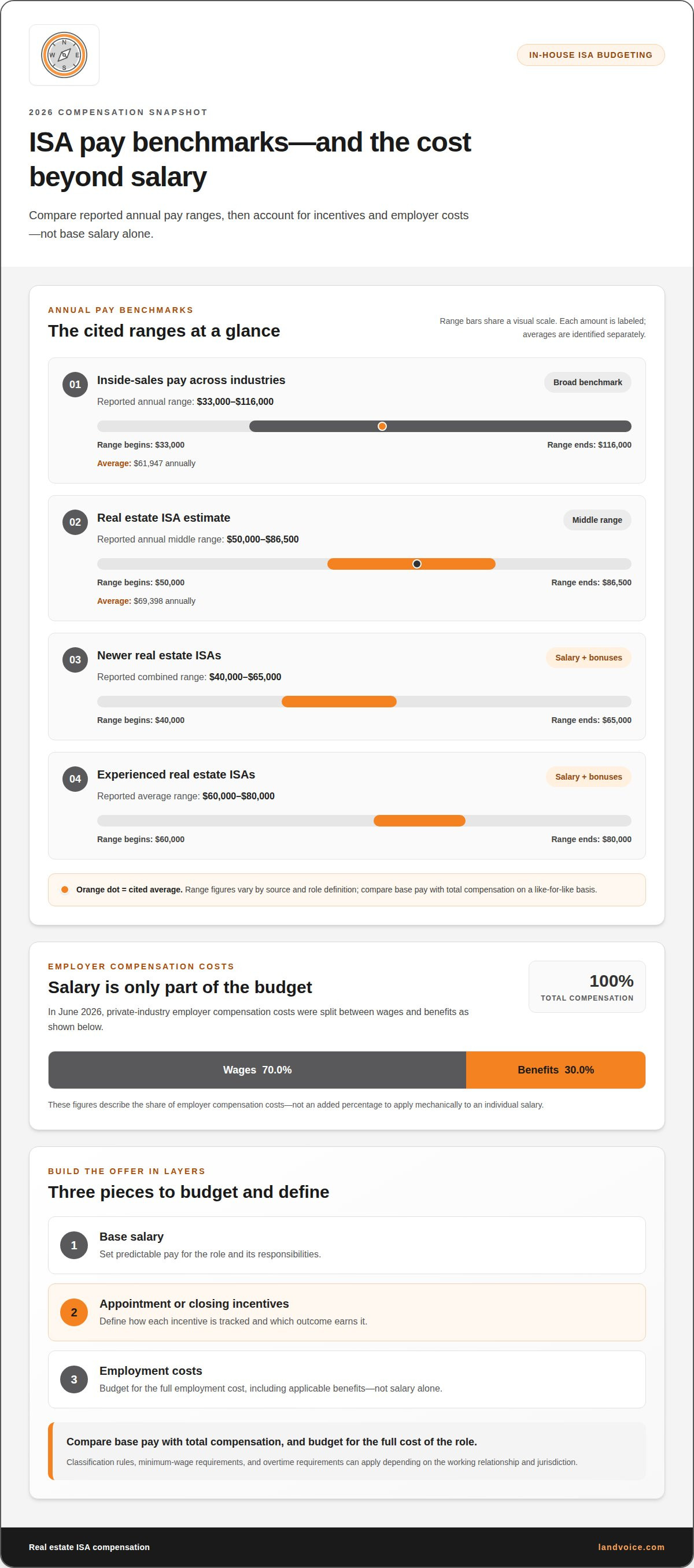
Inside-sales pay across industries averages $61,947 annually, with a broad range of roughly $33,000 to $116,000. Real estate ISA benchmarks vary by source and role definition: one October 2026 estimate puts average annual pay at $69,398, with a middle range of $50,000 to $86,500.
For real estate roles, base pay can vary by team and compensation structure. Newer ISAs may earn $40,000 to $65,000 in combined salary and bonuses, while experienced ISAs average $60,000 to $80,000. These figures distinguish base pay from total compensation, so compare like with like.
Pay Variation by State, Market, and Experience
State and local labor markets affect hiring competition and the salary needed to attract an assistant. Experience also shifts the range: the cited real estate ISA estimates place newer workers at $40,000 to $65,000 in salary and bonuses, versus $60,000 to $80,000 for experienced workers.
Compare candidates’ responsibilities, prospecting experience, and listing workflow duties before making an offer. A role focused on qualified conversations and follow-up may warrant a different incentive mix from one that includes broader sales support. The figures above are national benchmarks, not a state-by-state pay schedule.
Employee and Contractor Pay Rules
Federal and state classification tests can differ, and a contract label alone doesn’t determine whether an ISA is an employee or contractor. Base classification on the actual working relationship and the applicable jurisdiction’s rules.
For employees, applicable federal, state, and local minimum-wage and overtime requirements apply; commission plans must also meet relevant wage rules. Contractor arrangements are treated differently, so establish the correct classification before setting pay or drafting the contract.
Base Salary and Incentive Pay
Build the offer in layers: base salary, appointment or closing incentives, then employment costs. For example, an ISA with a $44,000 base salary and an appointment bonus has a different total compensation figure from a salary-only role. Define how the team will track each incentive and what outcome earns it.
Employer costs matter. In June 2026, wages represented 70.0% of private-industry employer compensation costs, with benefits accounting for 30.0%. Budget against total employment cost, not salary alone.
Use that full-cost figure to assess how your prospecting strategy supports listing conversations and closing goals. To strengthen the pipeline behind an ISA role, explore a focused prospecting workflow.
Choosing an ISA compensation model
Match the pay structure to the work your ISA controls, then track the outcomes agents need. Inbound, outbound, and virtual roles differ in lead flow, supervision, and payroll arrangements.
Inbound ISA Models
An inbound ISA handles prospects who contact the brokerage, making response and qualification central to the role. A base salary can cover reliable lead handling, while a bonus can recognize qualified conversations or appointments that meet agreed criteria.
Unlike outbound work, inbound volume depends on incoming inquiries rather than the ISA’s outreach activity. Define what counts as a qualified prospect, how to handle duplicate inquiries, and when an appointment qualifies for incentive pay. For example, an agreement might distinguish a scheduled consultation from a conversation that establishes the prospect’s needs and readiness.
Choose measures the ISA can influence. If agents control appointment availability or follow-up after handoff, don’t tie the entire bonus to a closing the ISA cannot manage.
Outbound ISA Models
An outbound ISA initiates contact and follows a defined prospecting process. A base-plus-incentive model can recognize consistent activity and outcomes, such as qualified appointments or deals attributed to the ISA’s work. The agreement should explain how attribution follows a prospect through agent follow-up and closing.
Compared with an inbound role, outbound compensation can account for prospecting consistency as well as appointment results. Avoid rewarding raw booking volume alone. Set a clear qualification standard, then align incentives with appointments that meet it or with documented downstream results.
For example, a brokerage could pair a steady salary with a bonus for qualified appointments, then review whether those conversations create opportunities agents can advance. Keep measures consistent across the team so the compensation strategy doesn’t favor easy bookings over useful prospects.
Virtual ISA Models
A virtual ISA may work remotely as an employee or through a contractor arrangement. The work itself can resemble an in-house role, but supervision, payroll, and responsibility for daily workflow may differ. Build the pay model around duties and deliverables, not simply the worker’s location.
Compare the expected schedule, lead handling, reporting, and agent handoffs before choosing salary or incentives. A remote assistant handling scheduled prospecting may be measured on activity, while an ISA qualifying incoming conversations may be assessed on response and handoff quality.
Turnover risk matters too. If a role depends on detailed brokerage knowledge, document scripts, qualification rules, and follow-up steps. That gives a replacement a defined process and keeps prospect handling consistent when staffing changes.
Incentive Risks and Best Practices
Brokerages risk paying for activity that doesn’t create useful opportunities. A booking-only commission can encourage rushed qualification, while a closing-only bonus can feel disconnected from an ISA’s direct work. Pair each incentive with a written definition, a tracking method, and a clear attribution window.
Before launch, document the base pay, bonus trigger, payout timing, and treatment of cancellations or shared prospects. Use the same definitions across agents, then review results against appointment quality, listing opportunities, and closing outcomes.
Then check whether the ISA can influence each measure. If an agent’s follow-up determines whether a prospect advances, separate the ISA’s handoff performance from the agent’s closing result. A balanced model rewards work the ISA controls and gives the brokerage a practical way to assess incentive costs.
Real estate ISA compensation and cost
An ISA’s true cost is the investment required to create qualified opportunities, not just the salary or monthly invoice. Compare total compensation with held appointments, qualified prospects, and transactions traceable to the ISA’s work. That view helps you judge whether the role supports your sellers and agents.
For an in-house example, an $80,000 annual loaded cost and $9,000 of gross commission kept per deal require about nine extra closings a year to cover the cost. That is a break-even illustration, not a promise of production. It also shows why brokerage splits and the commission actually retained matter more than headline gross commission.
Use a consistent calendar and funnel definition. Track qualified opportunities, held appointments, signed listing agreements, and closed transactions separately. If the ISA’s scripts generate activity but appointments fail to hold, the cost per useful opportunity rises. If appointments hold but agents don’t follow up, the bottleneck shifts downstream.
| Cost model | Example cost | Useful comparison |
|---|---|---|
| In-house ISA | $80,000 annual loaded cost | About nine additional closings at $9,000 retained commission per deal |
| Outsourced ISA | Monthly commitment against qualified outcomes | |
| Staffed virtual ISA service | Defined service scope against appointment quality | |
| Freelance real estate VA | Hours purchased against completed prospecting work |
Outsourcing can make costs easier to budget, but compare equivalent scopes. Match lead volume, coverage window, contact attempts, CRM, languages, setup, supervision, overages, and cancellation terms. A lower monthly fee may cover fewer hours or a narrower workflow. Compare the work delivered, not the invoice alone.
Some teams add a closing bonus of 10% of gross commission income. That can align pay with revenue, but attribution needs to follow the prospect through handoffs and closing. Document the calculation, the transaction source, and how shared prospects are treated. For appointment-based incentives, keep the held-meeting definition consistent with the team’s calendar records.
Use those examples to see how output changes unit cost. The decision is practical: favor the model whose measurable work fits your lead flow, follow-up capacity, and closing strategy.
What is the typical hourly pay for a real estate ISA in 2026?
A full-time real estate ISA in the United States averages about $21 an hour, or roughly $44,000 a year, based on a June 2026 estimate. Treat that figure as a benchmark, not a universal rate: experience, job duties, location, and incentive pay all affect total compensation.
Annual salary estimates give useful context for the hourly figure. Salary.com puts the median annual salary for a full-time real estate ISA near $56,000. Other estimates place typical in-house base pay between $44,000 and $60,000 a year. Those figures may reflect different roles and compensation methods, so compare base salary with base salary, then account separately for bonuses.
Hourly pay is most useful when the schedule or workload varies. For a part-time ISA, hourly compensation makes time worked visible; for a full-time employee, an annual salary can provide steadier pay as lead volume changes. In either case, document expected hours, core responsibilities, and how incentive pay is calculated. That makes the total offer easier to understand and compare.
That rate describes a freelance assistant, not necessarily an employee performing the same ISA role. Before comparing it with a $21 hourly employee benchmark, account for differences in duties, supervision, schedule, employment costs, and whether bonuses are included. A lower hourly figure alone doesn’t establish lower overall cost.
Use a consistent comparison process. First, separate guaranteed pay from performance bonuses. Next, match the workload and responsibilities, such as prospecting, lead qualification, and appointment follow-up. Then calculate expected total compensation for the same schedule. For example, comparing a salaried ISA with a freelancer means looking beyond the quoted hourly rate to the work delivered and the time needed to manage it.
For compensation models for a real estate ISA in 2026, hourly pay is one benchmark, not the whole decision. A base-plus-bonus offer can combine predictable earnings with incentives, while an hourly arrangement ties guaranteed pay to hours worked. Define the performance measures clearly, including whether bonuses depend on qualified appointments, held appointments, or another outcome. Clear terms help align the pay plan with your team’s workflow.
Set the rate around the actual role, then assess the full compensation package against the ISA’s responsibilities and results. That gives you a stronger hiring comparison than hourly pay alone.
Landvoice
Landvoice supports ISA prospecting and follow-up with real estate lead data. Its offerings include Expired Pro, FSBO Leads, FRBO Leads, and Pre-Foreclosure Leads. These sources can help your team focus outreach on homeowners and assess how ISA activity contributes to qualified conversations and listing opportunities. Use them when your team needs focused prospecting sources to support its compensation model.
Choose the lead categories that fit your team’s strategy and workflow. Contact Landvoice to discuss your prospecting needs.
Build a Compensation Plan Your Team Can Sustain
Your next step is to turn the pay structure into a clear operating plan. Decide what the ISA controls, what agents own after handoff, and how you’ll review progress. A practical approach to compensation models for a real estate ISA in 2026 connects incentives to work the team can track and act on.
Consistent prospecting also depends on having relevant opportunities to work. Landvoice offers Expired Pro, FSBO Leads, and FRBO Leads to support homeowner outreach. Align the lead sources with your team’s workflow, then assess whether the ISA can handle the resulting conversations and follow-up.
Set expectations, equip the team, and refine the process as you learn what drives productive conversations. A focused plan gives your ISA a stronger platform for creating opportunities.
Take the next step with clarity and put your team’s prospecting strategy in motion.
Frequently Asked Questions
Does an ISA pay for itself?
An ISA pays for itself when the additional commission your brokerage retains from attributable closings exceeds the role’s full cost. Evaluate this over a consistent period, including payroll, benefits, incentives, and tools. For example, compare opportunities sourced by the ISA with similar prospects handled without dedicated ISA support. Track lead source, appointment, agent follow-up, and closing in your CRM to identify where results come from.
How do teams pay their ISAs?
Teams use salary-only, hourly, commission-only, and hybrid arrangements. A hybrid plan can combine a guaranteed base with incentives tied to documented outcomes. Put the pay formula, attribution rules, and payout schedule in writing before work begins. For instance, define how the team records a prospect shared between two agents. Clear records make compensation reviews easier and reduce disagreements about which activity earned a bonus.
How much does an outsourced ISA cost?
Outsourced ISA services typically cost between $1,000 and $4,000 per month depending on the level of dedicated support and calling volume. The monthly fee is meaningful only alongside the work included: lead volume, coverage window, contact attempts, CRM use, setup, supervision, overages, and cancellation terms. Compare proposals using the same scope, then consider the internal time needed for agent handoffs and follow-up. Services with different coverage or deliverables may not be directly comparable.
What is the average real estate ISA salary in the US in 2026?
The average annual pay for real estate ISA jobs in the United States is $69,398, based on an October 2026 estimate. Use the figure as a national reference, not a guaranteed offer or a state-specific rate. For hiring decisions, separate base salary from incentive pay and consider the role’s responsibilities, experience requirements, and work schedule. That helps you compare the same compensation components across candidates.
How do real estate ISA compensation models compare: hourly, salary, commission, and hybrid?
Hourly pay connects compensation to hours worked, while salary provides a set base for the agreed role. Commission-only pay depends on the outcomes named in the plan. Hybrid compensation combines base pay with incentives, balancing predictable earnings and performance rewards. Choose according to workload and what the ISA can influence. For a role with changing weekly hours, hourly pay may align more easily with scheduled coverage.
What commission or bonus rates do real estate ISAs earn per qualified appointment or closed transaction?
Some teams pay $50 to $150 for each appointment conducted, and one suggested closing bonus is 5% of gross commission income after closing. Some teams use 10% of gross commission income. Rates and triggers vary by plan, so define qualified and held appointments, commission calculations, and transaction attribution in writing. Also state how shared prospects and cancellations affect eligibility, before the ISA begins earning incentives.
How should real estate teams calculate a real estate ISA compensation plan and cost per lead?
Add base pay, employer costs, incentives, and relevant tools to estimate total ISA expense for the period. Then divide that expense by the number of leads meeting your qualification standard. Track raw inquiries, qualified prospects, held appointments, and closed transactions separately. This shows whether higher lead volume improves efficiency or simply increases activity without creating more viable listing opportunities.
What are the pros and cons of paying a real estate ISA based on appointments versus closed deals?
Appointment-based bonuses reward a nearer-term result the ISA can influence, but a meeting alone may not become a listing. Closing-based bonuses connect compensation to revenue, yet agent follow-up and later transaction steps also affect the result. Appointment measures can support frequent feedback; closing measures emphasize downstream outcomes. A written plan can define attribution and distinguish ISA performance from agent follow-through, helping keep reviews consistent.
