



by Bruce Keith, on November 11, 2026
Empathy is not a pitch; it’s how you make room for a real conversation. To show empathy to a distressed homeowner, acknowledge the pressure they may be under, listen without judgment, and ask what would help before suggesting a next step. A respectful opening builds more trust than leading with assumptions about their circumstances.
It’s natural to want to offer a solution quickly, especially when timing matters. But homeowners need space to explain what’s happening and decide whether to continue the conversation. You can be clear and confident without rushing them or making assumptions.
Learn how to open with care, listen actively, respond to objections without pressure, and communicate transparently. These practical approaches can help you build trust while keeping each conversation focused on the homeowner’s needs.
Key Takeaways
- Acknowledge the homeowner’s situation with care, and avoid making assumptions about what they need.
- Use open-ended questions and attentive listening to understand what matters to the homeowner before suggesting a next step.
- Respond to objections calmly, respect a homeowner’s decision, and leave room for them to reconnect later.
- Build credibility by explaining your process clearly and following through on what you say you’ll do.
- Choose a warm, tactful opening that invites conversation without leading with sensitive details or pressure.
1. Empathetic communication with distressed homeowners
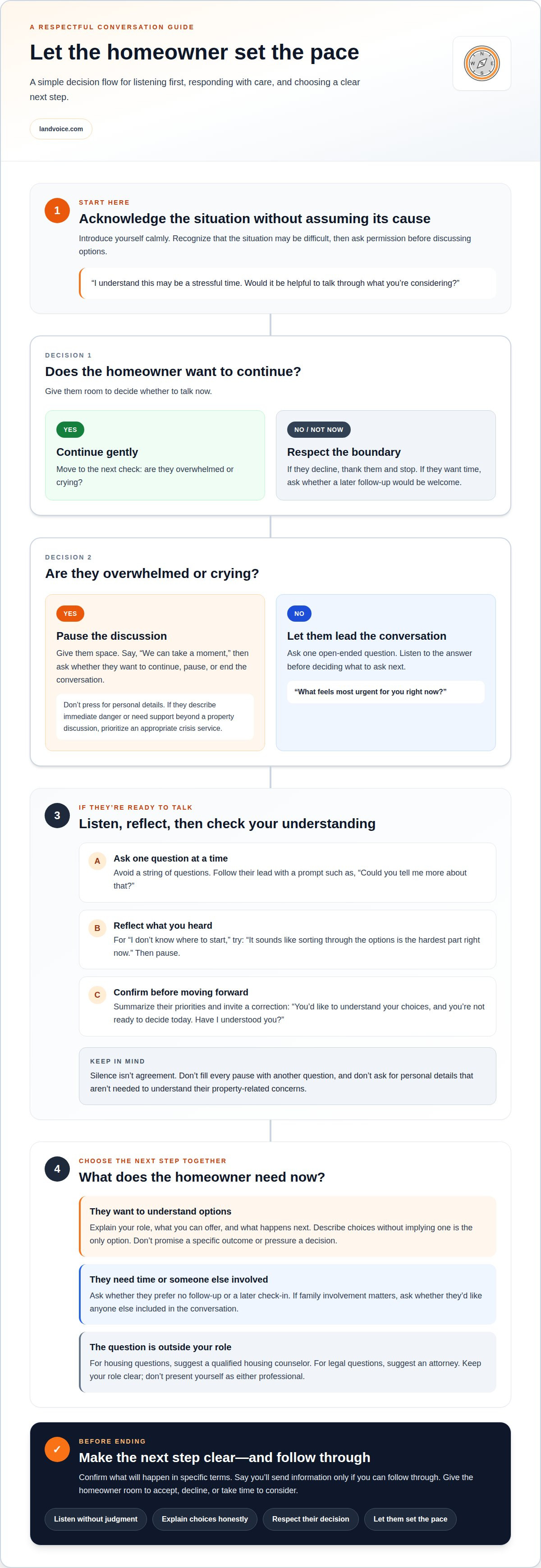
Knowing how to show empathy to a distressed homeowner starts with recognizing that a property problem can feel personal. Introduce yourself calmly, acknowledge the difficulty without assuming its cause, and ask permission to discuss options. For example: “I understand this may be a stressful time. Would it be helpful to talk through what you’re considering?” This lets the homeowner decide whether to continue.
Explain your value plainly. Describe a potential benefit, such as discussing a direct sale, and outline the steps without implying it is the homeowner’s only choice. Be clear about your role, what you can offer, and what happens next. Don’t promise a specific outcome or pressure them to decide. The homeowner should understand the proposal well enough to accept, decline, or take time to consider it.
Choose words that leave room for the homeowner’s perspective. Avoid phrases such as “You have to sell,” “This is your only option,” or “You should have acted sooner.” They can sound judgmental or coercive. Try “Would you like to share what options you’ve considered?” or “What would you like to understand before deciding?” A thoughtful question invites useful context without treating a difficult situation as a sales opportunity.
Offer help while respecting boundaries by asking what kind of conversation the homeowner wants, then honoring the answer. If they decline, thank them and stop; if they want time, ask whether a later follow-up would be welcome. When timing matters, explain the relevant next step and why it may matter, then let them choose. Clear, low-pressure information about options for distressed homeowners can support a more informed conversation without demanding an immediate commitment.
If a homeowner is overwhelmed or crying, pause your pitch and give them space. Say, “We can take a moment,” then ask whether they want to continue, pause, or end the conversation. Don’t press for personal details. If they describe immediate danger or need support beyond a property discussion, prioritize connecting them with an appropriate crisis service. For housing questions, suggest a qualified housing counselor; for legal questions, suggest an attorney. Keep your role clear, and don’t present yourself as either professional.
Community workshops can offer a less pressured setting to learn about options, including foreclosure avoidance and short sales. Share practical information, allow private questions, and explain when a topic falls outside your expertise. Compassionate communication is specific: listen, describe choices honestly, and let the homeowner set the pace.
Real estate professionals should acknowledge the homeowner’s difficult situation, communicate compassionately, and avoid sounding opportunistic. Educational resources can help distressed homeowners learn about avoiding foreclosure and understanding short sales. When timing matters, consider offering a no-obligation offer within 24 hours. The Federal Communications Commission says the Telephone Consumer Protection Act (TCPA) regulates contacting homeowners by phone in the United States. Loss mitigation professionals should consider borrowers’ personal stories and offer kindness and compassionate guidance.
2. Asking open-ended questions and listening actively
Open-ended questions help homeowners explain their priorities in their own words. Ask, “What feels most urgent for you right now?” rather than “Do you need to sell quickly?” The first invites context; the second narrows the conversation to yes or no. Keep your tone steady and let the homeowner choose where to begin. Their answer may reveal a concern you hadn’t considered, such as understanding their choices or having time to speak with family.
Ask one question at a time. A string of questions about payments, deadlines, property condition, and moving plans can feel like an interrogation. Start with a broad prompt, then follow the homeowner’s lead: “Could you tell me more about that?” Knowing how to show empathy to a distressed homeowner means letting their answer shape your next question. That keeps the conversation responsive instead of following a script regardless of what they say.
Listen for both the facts and the feelings behind them. If a homeowner says, “I don’t know where to start,” don’t jump straight into a pitch. Reflect what you heard: “It sounds like sorting through the options is the hardest part right now.” Then pause. This gives the homeowner a chance to correct your understanding or add detail. Don’t interpret silence as agreement or fill every pause with another question.
Keep notes focused on the homeowner’s stated concerns. For example, record that they want to understand the process before discussing a decision, rather than labeling them “unmotivated.” Then summarize the main points in plain language: “You’d like to understand your choices, and you’re not ready to decide today. Have I understood you?” This gives the homeowner a chance to clarify and helps prevent mistaken assumptions from shaping your follow-up.
Match your next question to what the homeowner has shared. If they mention family involvement, ask, “Would you like anyone else included in the conversation?” If they need time, ask whether they prefer no follow-up or a later check-in. Don’t ask for personal details that aren’t needed to understand their property-related concerns. A practical test of how to show empathy to a distressed homeowner is whether their preferences shape your next step.
Before ending, confirm the next step in specific terms. You might say, “I’ll send the information we discussed,” only if you can follow through. Otherwise, clarify what you can provide and invite questions. This gives the homeowner a clear record of the conversation without forcing a decision. Active listening is practical: ask, pause, reflect, confirm, and let the homeowner’s priorities guide what happens next.
3. Responding to homeowner objections without pressure
An objection tells you about the homeowner’s concerns; it isn’t an invitation to argue. If they say, “I’m not interested,” acknowledge their answer: “I understand. Thanks for telling me.” You can offer your contact information for later, but don’t keep pitching after they decline. A respectful ending honors the homeowner’s choice and keeps your response professional, even when the conversation ends quickly.
When a homeowner says, “I need to talk with my family,” don’t treat it as a stall to overcome. Try: “Of course. Would it help if I gave you a brief summary to share?” Then let them decide whether they want the information or another conversation. Don’t ask for a decision before they’ve had the discussion they requested. Their wish to consult someone else is a clear cue to slow down.
Some objections point to a specific information gap. If a homeowner says, “I don’t understand how a direct sale works,” answer plainly before discussing a next step. Explain your role and the process you can describe, then ask which part needs clarification. Don’t claim that a sale is the only solution or promise an outcome. Clear boundaries help the homeowner assess your proposal on its merits.
Timing concerns deserve a direct response. If someone says, “I can’t talk right now,” say, “Understood. Would you prefer that I leave my contact information, or should we end here?” Accept either answer. Don’t turn an urgent property situation into pressure for an immediate conversation. If the homeowner requests a later follow-up, agree on a time only when they choose one, and record that preference accurately.
Distinguish a question from a boundary. “What would happen next?” invites an explanation; “Please don’t contact me again” means you should end the outreach. Likewise, “I need time” isn’t permission to keep calling until the person responds. A simple acknowledgment, such as “I understand, I’ll respect that,” is stronger than a rebuttal. Your response to an objection shows whether the homeowner’s choices truly guide the conversation.
Use a steady response pattern: listen without interrupting, acknowledge the concern, answer only what you can address, then offer a choice. For example: “You’re concerned about making a rushed decision. I can explain the steps, or we can stop here. Which would you prefer?” If the homeowner declines, end politely and respect their stated preference. This keeps the conversation useful without turning an objection into a contest.
4. Building trust through transparency and follow-through
Be clear about your role, the information you have, and what you can do next. If you’re discussing a possible sale, explain the steps you can describe and what remains undecided. For example, distinguish an initial conversation from a formal offer. Don’t imply you’ve reviewed documents you haven’t seen or can control a lender’s decision. Clear limits help the homeowner understand your proposal and make an informed choice.
Turn every commitment into a clear action. If you promise to send a process summary, say what it will cover and when you expect to send it. If you agree to follow up only after the homeowner speaks with family, record that preference and honor it. When plans change, tell them promptly rather than leaving them to wonder. A small, completed commitment is more credible than a broad promise about what you might accomplish.
Set an update rhythm that matches the homeowner’s preference, not your sales calendar. Seventy percent of homebuyers want regular updates from their agents. That figure describes homebuyers broadly, not specifically distressed homeowners, so ask how the person wants updates delivered and how often. For example, confirm whether they prefer a phone conversation or written summary. If they ask for no further contact, respect that boundary instead of scheduling another message.
Keep explanations consistent from one conversation to the next. If you first describe a possible next step as an estimate, don’t later present it as a confirmed result. When a detail changes, identify what changed and explain why it matters in plain language. For example: “The information I shared earlier was preliminary. I can clarify what this new detail means before you decide whether to continue.” Direct corrections protect trust better than avoiding an uncomfortable clarification.
Handle personal stories with care. Don’t share a homeowner’s name, circumstances, or experience as a testimonial without permission. Keep private notes limited to details needed for the next agreed step, such as the homeowner’s preferred contact method or a document they requested. Before ending the conversation, recap the commitments: what you’ll send, when you’ll follow up, and what the homeowner has chosen. Then do exactly what you said. Following through makes transparency visible in your conduct.
A caller’s response to a homeowner’s worry or uncertainty can shape trust. Real estate professionals contacting homeowners can build trust with distressed homeowners by showing empathy, listening without judgment, explaining their process transparently, and following through on promises. Give the person room to describe what matters, acknowledge their concerns without dismissing them, and answer within the limits of what you know. A calm, attentive exchange can help the homeowner consider the information and decide what, if anything, they want to do next.
The figure that 70% of homebuyers want regular updates from their agents can inform your approach, but it does not establish a distressed homeowner’s preference. Ask what kind of contact would be useful, and let the homeowner set the pace. Keep updates relevant to the agreed next step, and make each check-in consistent with what you promised. Listening with care and following through reliably give transparency practical meaning.
5. Using empathetic openings with distressed homeowners
Your first sentence sets the tone before you discuss a property or possible solution. Start with your name, your role, and a respectful reason for reaching out. For example: “Hi, I’m Jordan, a real estate professional. Is this a good time to talk?” This is direct without assuming the homeowner wants help. If they’re unavailable, respect that and ask whether they’d prefer to end the conversation or choose another time.
If you’re aware of possible financial hardship, don’t open by announcing a foreclosure notice. That can feel intrusive and frame the person as a problem to solve. Instead, use a tactful transition: “I understand you may be weighing some property decisions. Would it be useful to discuss what options you’re considering?” Don’t claim to know the homeowner’s circumstances. Give them room to correct your understanding or decline the topic.
If a homeowner is facing foreclosure or financial hardship, say, “I’m sorry you’re dealing with a difficult situation. Would you like to tell me what kind of information would help?” This recognizes the challenge without promising a solution. Ask permission before discussing a possible sale, and explain your role clearly if they want to continue.
Build your opening around four parts: a warm greeting, a brief reason for contacting them, an open question, and a clear choice about what happens next. For example: “I’m calling about your property. If now isn’t a good time, we can stop here. If you’d like, I can explain why I reached out.” This makes your purpose clear while keeping control with the homeowner. Don’t lead with a pitch or sensitive details.
Timing should shape your tone, not become a lever for pressure. A homeowner six months into the foreclosure process may need a more educational, relationship-focused conversation. Offer to explain relevant options, then ask what they want to understand first. If they’re open to talking, you can suggest a brief 15-minute conversation, making clear they can decline. Don’t promise a particular result or suggest that delaying a conversation will automatically worsen their situation.
Prepare an opening that sounds natural aloud, then practice it with a colleague. Remove phrases that presume urgency or assign blame, such as “You need to act now” or “Why didn’t you sell earlier?” Replace them with a calm explanation and a question the homeowner can answer freely. The goal is simple: explain why you reached out, invite the homeowner’s perspective, and make the next step optional. A respectful opening sets that standard from the start.
Landvoice
Landvoice helps real estate professionals connect with homeowners through lead sources such as expired listings, FSBO properties, FRBO properties, and pre-foreclosures. These opportunities can support a consistent outreach workflow, while your preparation and listening shape each homeowner conversation. Use the approaches in this guide to communicate respectfully, clearly, and in a way that responds to the person’s choices. Lead information creates an opportunity to connect, not a reason to assume what a homeowner needs or pressure them toward a decision. Focus on understanding their situation, explaining your role, and offering a relevant next step only when they welcome one.
Contact Landvoice to discuss homeowner lead sources for your outreach.
Make empathy part of every conversation
Learning how to show empathy to a distressed homeowner is only the starting point. The lasting difference comes from making respect part of your outreach, including when a homeowner declines, needs time, or chooses another path. Let that standard guide how you prepare, communicate, and follow up. Each conversation is a chance to earn trust through your actions, not just your words.
Bring that approach to your next homeowner conversation. Be clear about why you’re reaching out, listen carefully to the person’s concerns, and let their preferences shape the next step. Strong outreach doesn’t require pressure. It takes preparation, sound judgment, and the discipline to honor the homeowner’s choices.
Explore how Landvoice can support your outreach
Keep showing up with clarity and care. Build a more thoughtful process, one respectful conversation at a time.
Frequently Asked Questions
What are practical ways to show empathy to a distressed homeowner?
Offer practical support that fits the homeowner’s immediate concern instead of assuming they want a particular solution. If they’re worried about understanding their options, ask whether a brief written recap would help. If they need to speak with someone else, give them space to do so. Use neutral language, avoid promises about outcomes, and make clear that they can decline further discussion.
How can you listen actively without judging or making assumptions?
Separate what the homeowner tells you from what you infer. If they say they’re unsure about their next move, don’t label them indecisive or assume they want to sell. Ask what they mean, then let them correct your understanding. For example: “When you say you need more time, what would be useful to consider first?” This keeps your response grounded in their words.
How can real estate agents or contractors communicate empathetically with distressed homeowners?
Be clear about your role and stay within it. An agent can explain property-related choices without presenting themselves as a financial or legal adviser. A contractor can describe relevant work and its scope without implying that repairs address every housing concern. For example, clarify what a proposed service covers, what it doesn’t, and whether the homeowner wants to discuss it further.
