



by Bruce Keith, on November 17, 2026
A short pitch can open a real conversation, but only if the value is clear. Learning how to explain your value proposition in 30 seconds means stating who you help, the problem you solve, and the benefit you deliver in a concise pitch. Lead with the customer’s need, not a long list of features.
People make decisions more readily when they understand what’s in it for them. The challenge is choosing the right words and adapting them to the person in front of you. This guide shows you how to shape your message for a specific audience, make the benefit concrete, and practice a natural delivery. You’ll leave with a simple structure for explaining your value clearly and confidently.
Key Takeaways
- Build your pitch around the audience you serve, the problem you solve, and the outcome you help create.
- Make the customer benefit clear before describing features or processes.
- Choose concise language that makes your value easy to understand and remember.
- Rehearse your delivery so you can sound confident and natural in conversation.
- Adapt your emphasis to the person and situation, while keeping your core value consistent.
What Is a Value Proposition?
A value proposition identifies the audience you serve, the problem you address, and the benefit you provide. A concise version gives your elevator pitch a clear focus and helps listeners understand why your offer matters.
-
Define the Startup Value Proposition
Write one sentence that names your target customer, their problem, and the outcome your business offers. A value proposition explains why a customer might choose your solution by connecting its capabilities to their needs. The U.S. Environmental Protection Agency describes this distinction as matching capabilities with customer requirements and clarifying what is possible.
For a startup, keep the statement focused on the customer’s need, not a catalogue of features. For example, a scheduling tool might help independent clinics reduce appointment gaps through simpler booking. The example names a customer, a practical problem, and a relevant benefit. Use that structure to make your own offer specific and easy to assess.
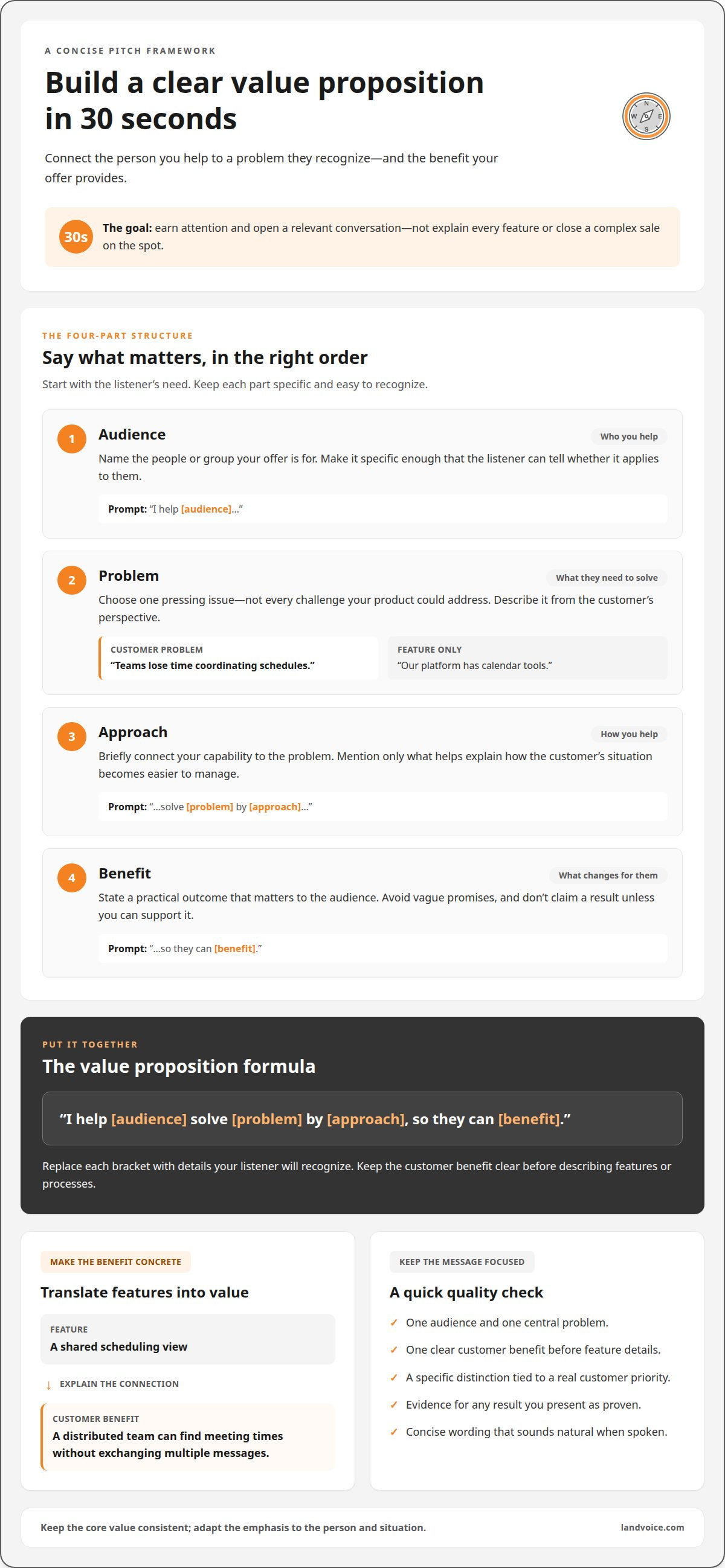
The best 30-second value proposition formula is: “I help [audience] solve [problem] by [approach], so they can [benefit].” Replace each bracket with details your listener will recognize.
-
Describe the Elevator Pitch
Shape your value proposition into a brief spoken explanation that fits within 30 seconds. An elevator pitch is a concise introduction to what you do, whom you help, and why your work matters. Its purpose is to earn attention and open a relevant conversation, not to explain every feature or close a complex sale on the spot.
Start with the audience’s concern, then state your response and the outcome. A laboratory example could explain how clearer reporting helps clinicians make sense of test results. According to CDC, reports say up to 70% of the data in the EMR is based on laboratory data. Use that fact only when it supports the listener’s needs and your organization’s work.
End with a natural next step, such as asking whether the person would like to hear how your approach works. That invitation keeps the pitch conversational and gives the listener an easy way to respond.
-
Differentiate From Competitors
Identify the customer requirement your offer serves especially well, then make that difference concrete. Compare the problem addressed, the audience served, and the benefit delivered instead of relying on broad claims like “best” or “innovative.” For instance, a business might stand out with a workflow designed for small clinics, if that focus genuinely reflects its capabilities.
To differentiate your value proposition, explain how your capabilities match a customer’s priority and what outcome they make possible. Avoid unsupported claims of superiority. A precise distinction gives listeners a useful reason to remember you.
Common mistakes include listing features without explaining their benefits, making vague promises, and cramming several messages into one pitch. Choose one audience and one central problem, then remove details that don’t strengthen that connection.
Explaining customer benefits and the problem solved
Build your message around the customer’s pressing problem, then connect your solution to a relevant benefit. This helps you show why your offer matters without leading with a feature list.
-
Identify the Customer’s Urgent Problem
Ask what is slowing your target customer down, creating risk, or blocking a goal. Then listen for a specific consequence, such as missed appointments, delayed decisions, or repeated manual work. Choose the problem that matters most to the audience you’re addressing, not every issue your product could solve.
Check that your wording reflects the customer’s perspective. “Teams lose time coordinating schedules” names a challenge; “our platform has calendar tools” describes a feature. If customers describe different problems, focus this pitch on one group and one pressing need.
-
Connect Features to Customer Problems
Pair each relevant feature with the problem it addresses and the practical change it enables. For example, a shared scheduling view can help a distributed team find available meeting times without exchanging multiple messages. Explain that connection directly rather than expecting listeners to infer the benefit from technical details.
Keep only the features that support the selected customer need. A long list of functions can obscure your main point and make your pitch harder to remember. Check each detail by asking, “Does this explain how the customer’s problem becomes easier to manage?”
-
Explain the Customer Benefits
Translate your solution into an outcome the customer values, such as clearer decisions, fewer handoffs, or a smoother booking process. Describe what changes for the customer after using it. Avoid claiming a specific result unless you can support it with evidence from actual customer experience.
Make the benefit concrete. Instead of saying “the experience is better,” explain that a customer can find the information needed to complete a task in one place. The right benefit depends on the audience’s priorities, so choose an outcome that addresses their central concern.
- Support your explanation with a customer case study when one is available. Structure it around the original problem, the solution used, and the result the customer experienced. For instance, describe how a business addressed a slow handoff process, what change it introduced, and what improved afterward. Use an actual customer experience, and get permission before sharing identifying details.
- Use a case study to make the benefit credible, not to overwhelm your pitch with background. Select one detail that connects directly to the listener’s situation. If no suitable case study exists, explain the feature-to-problem connection clearly and don’t present a hypothetical outcome as proven evidence.
Clear, concise, and compelling messaging
Build a pitch listeners can understand the first time they hear it. Use these steps to make every sentence support one clear message.
- Lead with a relevant opening. Start with a bold statement, a provocative question, or a surprising statistic that matters to your audience. For example, a scheduling service might ask, “How much time does your team lose coordinating meetings?” Choose an opening that connects directly to a problem your listener recognizes. Avoid dramatic claims you can’t support.
- Name your audience and what you do. State who you help and what you do in plain language. “I help independent clinics simplify patient appointment scheduling” gives listeners a clear picture. Replace broad labels like “businesses” with the specific audience you serve. Skip internal terminology and technical shorthand. Listeners shouldn’t have to decode your role to understand your offer.
- Explain the problem and the benefit. Connect your work to a customer challenge, then show the practical outcome. For example: “I help independent clinics simplify appointment scheduling so patients can book without repeated phone exchanges.” That second part makes the benefit visible. Don’t stop at a feature like “online booking.” Explain why it matters to the person using it.
- Keep the core pitch under 30 seconds. Aim for no more than two concise sentences that you can say naturally within that time. Remove details that don’t clarify the audience, the problem, or the benefit. If the pitch needs a long explanation of how the product works, save that for the follow-up conversation. A tight message creates room for the listener to respond.
- Add one proof point when it strengthens trust. Mention relevant experience, a credential, a customer story, or an award that supports your claim. For example, a consultant might describe experience helping clinics improve appointment workflows. Choose evidence that fits this audience and problem. Don’t stack unrelated credentials or imply results your evidence doesn’t demonstrate.
- Finish with a clear invitation. Give the listener an easy next step, such as asking whether they’d like to hear how the process works. Keep the invitation conversational and relevant to your pitch. Then pause. A pitch opens a conversation, it isn’t a monologue. Leave room for a question, concern, or sign that the listener wants more detail.
The question of how to explain your value proposition in 30 seconds becomes easier when you edit for clarity. Read the pitch aloud and remove any phrase that doesn’t help listeners understand your audience, solution, or benefit. To see how to explain your value proposition in 30 seconds in practice, focus on one clear message, then adapt its emphasis to the person you’re speaking with.
Delivery and practice tips
Test your pitch by asking a listener to explain what you offer and why it matters. Then rehearse aloud, clarify any confusing wording, and practice adapting your delivery to real conversations.
-
Practice the Delivery
Rehearse your pitch aloud in front of a mirror, with another person, or by recording yourself. Listen for rushed phrases, awkward pauses, and words that don’t sound like your usual speaking style. Keep the delivery conversational rather than memorized. A trusted listener can also flag jargon or details that make your message hard to follow.
- Time the spoken version. Use a timer while delivering your pitch at a natural pace. Keep it within 30 seconds, but don’t speed through important points to meet the limit. If you run long, remove repeated ideas and supporting details that belong in a follow-up conversation. The goal is clarity, not a race against the clock.
- Record and review one version. Play back a recording and note where your meaning becomes vague or your voice loses energy. For example, if “we provide integrated solutions” feels unclear, replace it with a plain description of the task you help customers complete. Make one focused edit, then record the revised version.
-
Test Message Clarity and Persuasiveness
Ask a listener who fits your target audience to hear your pitch once. Then ask them to describe whom you help, what problem you address, and what benefit you offer. If they can’t answer clearly, revise the phrase they misunderstood. Their response tests whether your message communicates value, not whether you simply like the wording.
- Check whether the pitch earns interest. Notice the listener’s response and invite a specific question, such as “Would you like to hear how that works?” A useful pitch gives them a reason to continue the conversation. If they ask what you mean, clarify that point first. Don’t respond by adding every feature or proof point at once.
- Practice in realistic situations. Deliver your pitch during a relevant conversation, such as a networking introduction or a meeting with a potential customer. Adjust your pace to the setting and listen for cues that the person wants more detail. Keep the core message steady, but emphasize what relates most to that listener’s concern.
Use feedback to improve one element at a time: clarity, pacing, or relevance. Once listeners can accurately describe your offer, keep the wording consistent and continue practicing in conversation.
Tailoring a pitch to different scenarios
Keep your central value consistent, but adjust the details that matter most to each listener. These steps help you adapt your pitch to the setting, audience, and next conversation.
- Identify the listener and setting. Before speaking, consider who’s listening and what they need from the conversation. A potential customer may want to understand a practical benefit; an investor may care more about the market need and business model. Choose one priority, then shape your opening around it. Don’t use the same emphasis for every audience.
- Adapt the message to the conversation. At a networking event, make your role and audience easy to grasp. In a sales conversation, connect your offer to the customer’s stated challenge. During a presentation, lead with the broader need before adding a supporting detail. The core value stays steady; the entry point changes with the listener’s interest.
- Use examples suited to each industry. Effective 30-second examples include a software founder saying, “I help small retailers track inventory so they can spot popular products sooner,” or an accountant saying, “I help freelancers organize business records so tax preparation feels more manageable.” A real estate professional might explain how they help homeowners understand their selling options. Each example names an audience, a need, and a benefit.
- Choose evidence that fits the audience. A business owner may respond to a customer story about simplifying a workflow, while a technical buyer may want to know how a feature addresses a specific requirement. Select one proof point relevant to that person. Don’t overload a brief introduction with case studies, credentials, and product details.
- Adjust your length to the situation. Keep an elevator pitch within 30 seconds when introducing your business or starting a quick conversation. In a job interview, a response to “Tell me about yourself” can last 30-60 seconds. Use that extra time to connect your experience to the role, rather than reciting your full work history.
- Prepare versions, not scripts for every person. Draft a core pitch and a few variations for common audiences, such as customers, partners, and employers. For each version, change the opening or proof point while preserving the central benefit. Rehearse each aloud, then adjust naturally to the listener’s questions and reactions.
This flexibility applies beyond individual conversations. A business should tailor its elevator pitch to the situation and audience, adjusting the emphasis to fit the exchange.
Companies may also develop different value propositions for different target markets. These variations let a business shape its message for each market instead of relying on an identical pitch for every audience.
Landvoice
Landvoice helps real estate professionals focus their outreach on homeowners who may be considering a sale. When your value proposition speaks to sellers, a clear audience and a relevant conversation make the benefit easier to explain. Expired Pro, FSBO Leads, FRBO Leads, and Pre-Foreclosure Leads support different prospecting goals, helping you tailor your message to a homeowner’s situation rather than relying on a one-size-fits-all pitch.
Use the same principle from this guide: connect the audience’s needs with the value you bring, then keep the message direct. When you’re ready to strengthen your homeowner outreach, contact Landvoice.
Put Your Value Proposition to Work
Knowing how to explain your value proposition in 30 seconds gives you a practical way to start sharper conversations. Treat the pitch as a working message, not a line you recite without thinking. Use it to open a relevant discussion, then let the other person’s priorities guide what you explain next. Your value becomes clearer when your words connect with the real needs you hear.
Choose an upcoming conversation and use your message. Notice which details prompt interest, which need clarification, and where the discussion naturally leads. Those signals can help you refine how you present your value. For real estate professionals building homeowner outreach, connect a clear message with a consistent prospecting approach.
Contact Landvoice to learn more
Keep moving forward. A focused message gives you a stronger starting point for every meaningful conversation.
Frequently Asked Questions
First things first: What is an elevator pitch?
An elevator pitch is a brief spoken introduction that explains your work and invites further conversation. Imagine meeting a potential partner before a presentation begins: you have a moment to say what you do and why it may matter to them. It isn’t a full product demonstration or a memorized sales script. Treat it as an opening that earns attention and gives the other person a clear reason to respond.
What is a value proposition and what should it communicate?
A value proposition is a clear statement of the value your work offers a particular audience. It should help someone understand whom you serve, what need you address, and why your approach is relevant. For example, a bookkeeping firm might explain how it helps independent consultants keep project records organized. Listeners should understand how the value offered fits their needs.
How do you explain the benefit or outcome you offer in a concise way?
Describe the change your customer can expect in plain, specific language. For example, a language tutor might say, “I help new managers lead clearer meetings with international teams.” That communicates an outcome more clearly than “I provide customized language instruction.” Choose a benefit your solution genuinely supports, then remove technical details that don’t help listeners picture the difference.
How should you tailor a value proposition for a job interview, sales pitch, or networking event?
Keep your central message consistent, but emphasize what matters in each setting. In a job interview, connect your experience to the role; an answer to “Tell me about yourself” should last 30-60 seconds. In a sales conversation, focus on the prospect’s stated need. At a networking event, make your work and the people you help easy to understand, then invite a relevant follow-up conversation.
How do you practice and time a 30-second value proposition?
Read your pitch aloud while timing it, then record a version and listen for rushed phrases or unclear wording. Ask someone unfamiliar with your work to explain what they understood. If they miss your audience or main benefit, revise the confusing phrase rather than adding detail. Practice the revised version in conversation, keep your pace natural, and leave room for the other person’s response.
