



by Bruce Keith, on October 31, 2026
A busy seller isn’t necessarily a closed door. A strong script for when a seller says they’re too busy to talk acknowledges their time, asks one focused question, and offers a clear next step. These five scripts help you respond without pressure and keep a promising conversation from drifting away.
It’s frustrating when you’ve prepared to connect and hear, “I’m too busy.” But pushing harder can end the conversation, while a calm, respectful response gives the seller room to engage. You’ll learn how to uncover pain points, show empathy, set expectations, and follow up by phone with a useful reason to reconnect. Each script is designed to help you stay direct, protect the seller’s time, and move the conversation forward when they’re ready.
Key Takeaways
- Ask one focused question to uncover what’s making the seller’s situation challenging, rather than rushing into a pitch.
- Acknowledge the seller’s time constraint and let their response guide whether to continue or reconnect later.
- Agree on a clear next step and a specific time to follow up before ending the conversation.
- Make phone follow-ups relevant to the seller’s interest and previous conversation.
- Keep voicemails and texts brief, personal, and easy to respond to.
1. Asking about prospect pain points
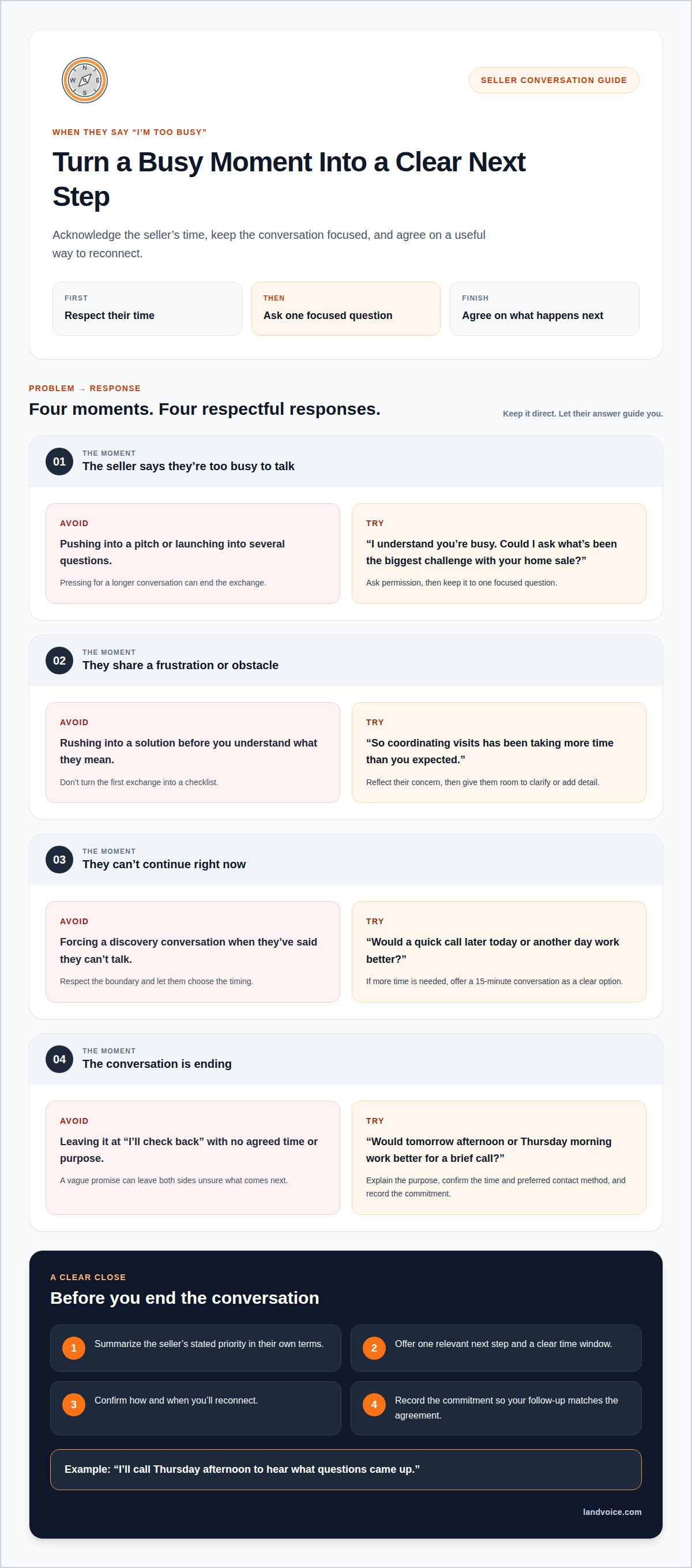
A script for when a seller says they're too busy to talk should uncover what matters without demanding a long conversation. Acknowledge the interruption, then ask permission to pose one focused question. For example: “I understand you’re busy. Could I ask what’s been the biggest challenge with your home sale?” The seller can answer briefly, and you can learn whether timing, pricing, showings, or something else needs attention.
Keep your first question open-ended but specific to the seller’s situation. Try, “What would you most like to change about the selling process right now?” If they mention missed calls or inconvenient showings, reflect what you heard: “So coordinating visits has been taking more time than you expected.” This shows you’re listening and gives the seller an easy chance to clarify or add detail.
If the seller can’t talk, don’t force a discovery conversation. Offer a low-friction choice: “Would a quick call later today or another day work better?” A 15-minute conversation can be a clear option when more time is needed to discuss their goals. If they decline, ask when they’d prefer you to reconnect, then respect that answer and make a note of the agreed next step.
Ask follow-up questions to understand the real obstacle, not to work through a checklist. Ask one question at a time, and let the seller’s answer guide what comes next:
- “What has been the most frustrating part of selling so far?”
- “What would need to happen for the process to feel easier?”
- “Is there one issue you’d want addressed before considering your next step?”
Visitors can also offer useful feedback about a listing. After a showing, ask what stood out, what gave them pause, and whether anything made the home harder to consider. Keep your questions neutral. “What would you change?” invites more useful detail than “Did you like it?” Share relevant patterns with the seller, distinguishing repeated observations from one person’s preference.
That feedback can help you ask the seller a more focused question. If several visitors mention the same concern, you might say, “A few visitors have raised questions about the layout. Is that something you’ve been thinking about?” Don’t present one comment as a broad market verdict. Give the seller space to explain how the feedback relates to their priorities.
The Rule of 7 describes engaging a prospect seven times to help earn trust and get a sale. Treat those contacts as opportunities to offer relevant value, not as reasons to repeat the same pitch. Each conversation can build on the seller’s stated concern, such as scheduling or uncertainty about buyer feedback. Your goal in the first exchange is simple: identify one pain point, confirm you understood it, and agree on a respectful next step.
3. Setting expectations and identifying next steps
End a productive conversation with a clear next step, not a vague promise to reconnect. If a seller says they’re busy, offer a quick choice: “Would tomorrow afternoon or Thursday morning work better for a brief call?” Explain the purpose, such as discussing their timeline or the next step for the listing. Then confirm the agreed time and preferred contact method.
Keep the commitment realistic and specific. A 20-minute meeting can provide a defined window to review a plan without leaving the seller guessing about how long it will take. In a warm-lead sales script, one approach is asking whether the prospect is available for a 20-minute demo or product review. For a homeowner, adapt that bounded-time approach to a relevant conversation, such as reviewing their selling priorities.
Set expectations before ending the call. Explain what you’ll discuss, what information might help, and what the seller can expect afterward. For example: “We’ll use the call to discuss your preferred timeline and the questions you want answered. Then we can decide whether another conversation makes sense.” Don’t imply that a brief call will resolve every concern or guarantee a particular result.
When a conversation involves interest in a property, pay attention to whether the buyer is seriously engaged. A phone follow-up makes sense when they’ve asked about next steps or engaged in detail. Look for meaningful signals, such as questions about the home’s features, a request to discuss the process, or a direct question about how to proceed. A quick glance or general compliment alone is less reason to assume strong intent.
When someone shows genuine interest, make the next step easy to accept. Ask, “Would it help to talk through your questions by phone?” If they agree, set a time and explain the call’s purpose. If they’re not ready, ask what information would help them decide whether to continue. That gives you a relevant follow-up topic rather than a reason to check in without context.
Use this simple sequence to end the conversation clearly:
- Summarize the seller’s stated priority in their own terms.
- Offer one relevant next step and a clear time window.
- Confirm how and when you’ll reconnect.
- Record the commitment so your follow-up matches the agreement.
For example, if a seller needs time to review options, say, “I’ll call Thursday afternoon to hear what questions came up.” A structured approach to seller conversations can help you keep each next step focused and useful.
4. Active listening and empathy
When a seller says, “I’m too busy,” listen to both their words and the boundary they’re setting. Don’t jump straight into another pitch or question. Try: “I hear you. It sounds like now isn’t a good time.” Then pause. That moment gives the seller room to correct you, add context, or end the conversation without pressure.
Respond to the seller’s actual concern rather than assuming what they mean. “I’m heading into a meeting” calls for a different response than “I’ve had too many calls about the property.” You could say, “Understood. I’ll keep this brief,” or, “I can see why repeated calls would be frustrating.” A specific acknowledgment sounds more attentive than a generic “I understand.”
Listen for useful details, including the seller’s wording, tone, and preferred timing. If they say, “I can’t discuss this while I’m at work,” don’t treat it as an invitation to keep explaining. Say, “Of course. Would you prefer I reconnect after work, or should I leave it there?” Their answer tells you whether to schedule a follow-up or end the conversation.
Briefly reflect what you heard before responding. For example: “You’re managing showings and work, so a longer call isn’t practical right now.” If the seller replies, “Actually, I’m mostly concerned about the calls,” adjust your response. This keeps the conversation grounded in what they said, not your assumptions about their priorities.
- Pause: Let the seller finish before you respond.
- Reflect: Repeat the main concern in plain language.
- Clarify: Ask whether your understanding is accurate.
- Respect: Follow the seller’s preference about continuing or reconnecting.
Empathy doesn’t mean agreeing with every claim or making promises. If a seller says, “No one who calls can help me,” don’t argue. Respond, “It sounds like you’ve had frustrating conversations. I won’t push you. Would you like me to end the call?” This acknowledges their experience and lets them decide what happens next.
Your tone helps determine whether your words feel respectful. Speak steadily, avoid interrupting, and keep your response concise if the seller sounds rushed. If they cut in with, “I really have to go,” say, “Understood. I’ll let you get back to it.” Don’t add a last-minute pitch after acknowledging their limit. Empathy feels credible when your actions match your words.
After the conversation, record the seller’s own words and any contact preference they shared. Note “asked not to discuss during work hours,” rather than labeling them “difficult.” That distinction helps you respond thoughtfully next time and respect the boundary they set.
5. Following up by phone
A follow-up call works best when it respects the seller’s stated preference. Before dialing, review your notes for the agreed time, contact method, and reason for reconnecting. If the seller asked you to call after work about listing questions, open with that context: “Hi, we spoke earlier, and you suggested I call after work. Is now still a good time?” This makes the call feel relevant rather than like another interruption.
Keep your opening brief and make it easy for the seller to continue or reschedule. Try: “I’m calling about the timing you mentioned for your sale. Do you have a moment, or would another time work better?” If they’re still busy, accept that and ask when they’d prefer you to try again. Don’t launch into a pitch before confirming they can talk.
Give a follow-up call one clear purpose. Refer to the seller’s earlier concern, then ask a focused question. For example: “You mentioned that coordinating showings has been difficult. Has anything changed since we last spoke?” If the seller raises a different issue, listen and follow that thread. Don’t force the original agenda if their priorities have shifted.
A phone follow-up with a serious buyer makes sense after meaningful engagement or a direct question about next steps. Refer to the specific signal: “You asked about the next step after viewing the home. Would you like to talk through your questions?” Someone who expressed only general interest may be better suited to a lighter follow-up. Match your call to what they actually asked or discussed.
- Identify yourself and recall the earlier conversation.
- Check whether the seller can talk now.
- State the reason for calling in one sentence.
- Ask one relevant question, then listen.
- Agree on the next step or end the call politely.
Choose a time that reflects the person’s schedule, not a universal calling window. Three p.m. might suit restaurant owners during the lull between lunch and dinner, but that example is specific to restaurant owners. For a homeowner, use the time they requested rather than assuming the same schedule applies.
If you reach voicemail, leave a short message with your name, reason for calling, and a clear invitation to reconnect. For example: “Hi, this is Alex. I’m following up on the timing you mentioned for discussing your sale. You can return my call when convenient.” Don’t include several requests in one message. Then note the attempt and any response so your next contact respects the seller’s preferences.
5. What are effective voicemail and text scripts for following up with a busy seller?
A useful voicemail or text gives the seller context, a reason to respond, and room to choose. Start with your name, remind them why you’re reaching out, and make one simple request. For example: “Hi, this is Jordan Lee. We spoke about your plans for the property. I’m following up on the timing you mentioned. Call or text when you have a convenient moment.” This is specific without demanding an immediate conversation.
Keep a voicemail focused on the seller’s earlier concern. If they mentioned having limited time, try: “Hi, this is Jordan Lee. I know your schedule was tight when we spoke. I’m calling to follow up on your question about the sale. If you’d like to continue the conversation, please call me back when it works for you.” Speak calmly, say your name clearly, and avoid adding multiple topics.
A text can make the next step even easier to answer. If the seller asked you to reconnect later, send: “Hi, this is Jordan. You asked me to follow up about your selling plans. Is now a better time to talk, or would you prefer I reach out another time?” This lets the homeowner share a preference without composing a detailed reply.
Adapt your message to the seller’s last words. If they said, “I’m busy with work,” write: “I know work was keeping you occupied when we spoke. Would you prefer a quick call after your workday, or another time?” If they asked for information first, send a brief note related to that request: “You asked about discussing your listing timeline. I’m available to talk through your questions when convenient.” Don’t say you’ve sent information unless you actually included it.
Keep every message focused on one purpose. A voicemail shouldn’t ask the seller to call, review a document, and choose a meeting time all at once. Avoid a long pitch or several questions in a text. Before sending, check that the name, property context, and next step match your conversation. The wrong detail can make a thoughtful follow-up feel generic.
Use this sequence before you send:
- Review what the seller asked you to do.
- Choose phone or text based on their stated preference.
- Include one relevant detail from your conversation.
- End with a clear, low-pressure response option.
- Record the message and any reply for your next contact.
If the seller doesn’t respond, don’t keep sending the same message. Review the agreed timing and reason for reconnecting. If they reply that they’re still unavailable, acknowledge their message and let them guide the next step: “Understood. Would you like me to check back another time, or leave it with you?” Their answer gives you direction and keeps your follow-up respectful.
Landvoice: Expired Pro
Landvoice offers Expired Pro to real estate agents seeking to connect with homeowners whose listings have expired. It can support your outreach as you build conversations with potential sellers and use the respectful follow-up strategies in this guide. Tailor your approach to the seller’s situation, and make the next step clear and considerate.
If expired listings fit your prospecting goals, explore Expired Pro leads as a way to focus your outreach. Visit Landvoice to learn more.
Turn the Next Conversation Into a Clear Step Forward
A seller’s “not now” doesn’t have to end your outreach. Build on what the homeowner has shared, respect their timing, and offer a useful reason to reconnect. A well-prepared script for when a seller says they’re too busy to talk helps you stay focused without making the exchange feel forced.
As you refine your prospecting, match your outreach to the seller group you want to reach. Landvoice offers FSBO Leads and FRBO Leads to help agents connect with homeowners and build their seller prospect pipeline.
Choose a thoughtful next step, follow through, and learn from each conversation. Consistent, relevant outreach helps you build meaningful connections with sellers.
Make your next contact count. You’re ready to move the conversation forward.
Frequently Asked Questions
What should I say when a seller says they’re too busy to talk?
Acknowledge the seller’s time constraint and give them control over the conversation. You might say, “I understand. I’ll keep this brief. Would you prefer I try again later, or is there a better time?” A useful script for when a seller says they’re too busy to talk stays calm and gives the homeowner an easy choice. If they can’t speak, thank them and end the call politely.
What is a short script for asking a busy seller to schedule a callback?
Try: “I understand you’re occupied. Could we schedule a brief callback to discuss your property? What time works better for you?” If the seller suggests a time, repeat it to confirm you heard correctly. For example, “I’ll call Thursday afternoon, as you requested.” Don’t commit to a specific time unless the seller agrees. A mutually agreed callback makes the purpose of your next contact clear.
How can I ask a seller when they would be available without sounding pushy?
Make the question optional and let the seller choose the timing. Say, “Would you like me to try another time, or would you rather reach out if your schedule opens up?” This makes clear that continuing is their choice. If they suggest a window, confirm it without negotiating for an earlier one. If they don’t suggest a time, thank them and don’t treat silence as permission to keep contacting them.
What follow-up questions can I ask a seller who says they’re too busy?
Ask only a question that helps the seller decide what happens next. For example: “Would a message with my contact details be more useful than another call?” Or, “Is there one question about the sale you’d like me to address when we reconnect?” These options don’t require the homeowner to explain their whole situation. If they decline to continue, accept their response rather than asking another discovery question.
How should I respond if a seller says they are not interested because they’re busy?
Treat “not interested” as a clear answer, not just a scheduling objection. Respond, “Understood. I won’t take more of your time. Thanks for letting me know.” Don’t assume a callback will change their mind or ask them to justify their decision. If they clarify that they’re only unavailable right now, ask whether they want you to reconnect. Let their answer determine whether follow-up is appropriate.
How many times should I follow up with a busy seller, and how far apart should attempts be?
Base follow-up on the seller’s stated preference, not an arbitrary sequence. If they asked you to reconnect on a particular day, honor that request. If they didn’t invite further contact, don’t invent a schedule or repeat the same message. A relevant update can give a follow-up a clear purpose, while repeated attempts without permission or new context may disregard the seller’s wishes.
How can I tailor a busy-seller script for real estate investors, agents, or home buyers?
Match your wording to your role and the person’s goal. An agent might ask a homeowner whether they want to discuss listing plans. An investor can briefly explain why they’re contacting the owner, then ask whether the owner is open to a conversation. A home buyer should identify themselves as a prospective buyer and ask about the property. In every case, don’t imply a relationship or offer that doesn’t exist.
